.png?height=200&name=How%20Subject%20Matter%20Expert%20workload%20really%20functions%20in%20HEVET%20(and%20where%20purpose-built%20LX%20support%20fits).png)
In Australian Higher Education (HE) and VET, there’s no one-size-fits-all when it comes to how...
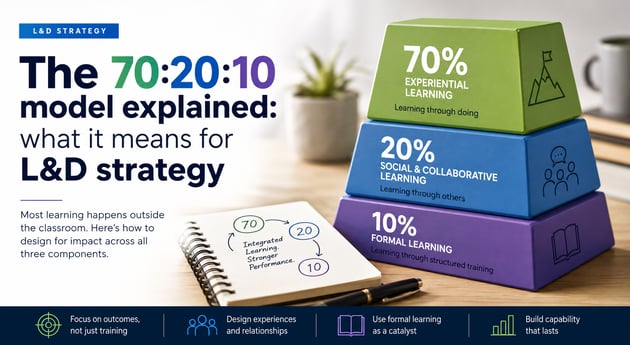
The 70:20:10 model is one of the most widely cited frameworks in learning and development. It proposes that, for most professionals, roughly 70 per cent of learning comes from on-the-job experience, 20 per cent from interactions with others like colleagues, managers, mentors and 10 per cent from formal training and structured learning events. The proportions are approximate and contextual, not a prescription. What the model is pointing at, however, is worth taking seriously: most capability development happens outside the classroom or the course, and L&D strategy should reflect that.
Where the model comes from
The 70:20:10 framework emerged from research conducted at the Center for Creative Leadership in the 1980s by Morgan McCall, Michael Lombardo, and Robert Eichinger. Their original study asked senior executives to reflect on the experiences that had been most formative in their development. The 70:20:10 ratio was a finding from that research and it specifically described the development of leadership capability in a corporate context.
It was not designed as a universal law of learning, and the original researchers were clear about that. The proportions will vary significantly by role, industry, and learning objective. A surgical trainee's development profile looks very different from a marketing director's. The value of 70:20:10 is not in the specific numbers, it is in the principle that formal training is a small part of how professional capability actually develops.
What the three components mean in practice
70% — experiential learning
This is learning that happens through doing: stretch assignments, new projects, problem-solving in the flow of work, exposure to unfamiliar challenges. It is the most powerful component of the model because it is embedded in real context, with real stakes and real feedback. L&D's role here is not to deliver the experience but to create conditions for it — through role design, structured reflection, and performance support that helps learners extract insight from experience rather than simply accumulating time in a role.
20% — social and collaborative learning
This is learning that happens through relationships: feedback from managers, observation of high performers, mentoring, peer discussion, and collaborative problem-solving. It is where tacit knowledge — the knowledge that experienced practitioners hold but rarely make explicit — is most naturally transmitted. L&D can support this component by designing mentoring programs, structured peer learning, and communities of practice, rather than assuming it happens informally without design intent.
10% — formal learning
This is where most L&D investment goes, and where the model offers its most pointed challenge. Formal learning — courses, workshops, eLearning modules, credentials — is a relatively small contributor to overall capability development. That does not mean it is unimportant. Formal learning is particularly well-suited to introducing new frameworks, establishing shared language, meeting compliance requirements, and providing foundational knowledge that experiential learning can then build on. The question the model asks is whether the investment is proportionate to the contribution.
Common misreadings of the model
The 70:20:10 model is frequently misused as a budget argument and as a rationale for cutting formal training investment without building anything to replace it. That misses the point. The model is an argument for designing intentionally across all three components, not for defunding one of them.
It is also sometimes taken as a precise target. For example, organisations often attempt to engineer programs that are "70% experiential" as if the ratio were a compliance requirement. This misunderstands how the framework is meant to function. The 70, 20, and 10 are descriptions of how learning tends to happen, not specifications for how it should be designed.
A third misreading treats the 10% as a ceiling on the value of formal learning. In reality, formal learning can be a catalyst for the other 70%. A well-designed course that gives practitioners a framework for interpreting and learning from experience multiplies the impact of the experiential component. It also gives people a lens through which to extract more value from what they are already doing. The blended learning approach is particularly well-suited to leveraging this relationship.
How to apply 70:20:10 in L&D strategy
Applying the model usefully requires stepping back from program design to curriculum strategy. Instead of asking "what should this course cover?", the question becomes "what is the full development pathway for this capability, and what role should each component play?"
Here is an example of a structured approach.
STEP 1: Map the capability
What does excellent performance look like in this role or context? What do high performers do that others do not? This connects directly to the training needs analysis process and produces the outcome picture that all three components should work toward.
STEP 2: Identify what formal learning should do
Formal learning is most efficient at providing frameworks, shared concepts, and foundational knowledge. Identify what a learner needs to understand before they can learn effectively from experience — and design formal learning to address that, not to cover everything.
STEP 3: Design for experience
What assignments, projects, or challenges will create the conditions for the 70%? This may involve working with managers and operations to create structured stretch opportunities, or designing performance support tools that help learners extract insight from the experiences they are already having.
STEP 4: Build the social infrastructure
Who are the high performers and practitioners with relevant tacit knowledge? What formal or informal structures — mentoring relationships, peer learning groups, team debriefs — will create opportunities for that knowledge to transfer?
The model is most useful when it shifts L&D from being a course-delivery function to being a capability-development function (and one that designs across the full range of conditions in which professional learning actually happens). Understanding adult learning principles alongside 70:20:10 provides the theoretical grounding for why this broader approach tends to produce more durable capability outcomes than formal training alone.
Oppida designs learning programs that work across all three components of the 70:20:10 framework, from structured eLearning and blended delivery through to performance support tools that help learners apply capability on the job. Find out how we work.
Frequently asked questions
Is the 70:20:10 model evidence-based?
The model is based on research conducted at the Center for Creative Leadership in the 1980s, which found that senior executives attributed roughly 70% of their development to challenging job experiences, 20% to relationships and feedback, and 10% to formal training. It is a useful descriptive framework, not a scientifically precise formula. The proportions will vary by role, context, and learning objective, and the model was originally developed for leadership capability specifically.
Does 70:20:10 mean organisations should spend less on formal training?
Not necessarily. The model is an argument for designing intentionally across all three learning components, not for defunding formal training. It suggests that formal training investment should be proportionate to its contribution, and that L&D should also invest in the conditions that support experiential and social learning, not just course delivery.
How does 70:20:10 apply to online or eLearning contexts?
The model applies regardless of delivery mode. In an online or hybrid context, the 10% might include eLearning modules and virtual workshops; the 20% includes online communities, peer learning, and digital mentoring; and the 70% includes on-the-job application supported by digital performance support tools. The shift to digital delivery does not change the underlying principle that most learning happens through experience and social interaction.
What is the difference between 70:20:10 and blended learning?
Blended learning refers to combining different delivery modes, typically formal online and face-to-face learning. 70:20:10 is a broader framework about the full range of conditions in which professional development occurs. Blended learning typically operates within the 10% formal learning component of 70:20:10, though a well-designed blended program can be structured to support the 20% (social and collaborative) component as well.