---
title: Course development review cycles without the chaos
description: Streamline your course development review cycles with structured processes that enhance clarity, reduce chaos, and ensure high-quality results for learning projects.
image: https://blog.oppida.co/hubfs/Course%20development%20review%20cycles%20without%20the%20chaos.png
---
16/12/2025
# Course development review cycles without the chaos
[ Oppida Team ](https://blog.oppida.co/author/oppida-team)
Share: [facebook-f icon ](http://www.facebook.com/share.php?u=https://blog.oppida.co/course-development-review-cycles) [linkedin-in icon ](http://www.linkedin.com/shareArticle?mini=true&url=https://blog.oppida.co/course-development-review-cycles) [Twitter icon ](https://twitter.com/intent/tweet?url=https://blog.oppida.co/course-development-review-cycles) [pinterest-p icon ](http://pinterest.com/pin/create/link/?url=https://blog.oppida.co/course-development-review-cycles) [envelope icon ](mailto:?body=https://blog.oppida.co/course-development-review-cycles)
Course development review cycles without the chaos
6:55
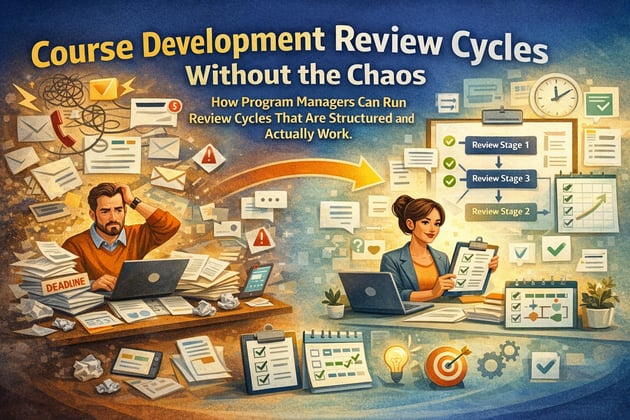
*How Program Managers can run review cycles that are structured and actually work.*
**
Review cycles have a reputation.
They sneak in with good intentions but often leave a trail of email threads, missed deadlines, and collective confusion in their wake.
If you’re a Program Manager, we bet you’ve felt this.
One minute, you’re tracking to plan. The next?
You’re chasing feedback across five platforms, refereeing Subject Matter Expert (SME) disagreements, and trying to explain to leadership why things are taking just a little longer than expected.
Here’s the thing…
It’s not that people aren’t doing their best. They are.
It’s that the review process wasn’t designed to support that best.
At Oppida, we’ve delivered over 250 learning projects, and the same pattern pops up time and again:
Reactive reviews lead to slow, stressful projects.
Structured reviews?
They bring clarity and quality.
This guide is for Program Managers like you (especially those working in government, higher ed, or the not-for-profit space) who need to keep learning projects compliant, high-quality, and most importantly, moving.
## You are the calm in the storm
Let’s take a moment to acknowledge your role.
You’re probably the one holding it all together.
You’ve got SMEs, legal, instructional designers, and accessibility auditors all wanting different things, sometimes at the same time.
You're not here to create bureaucracy.
You’re here to create clarity.
You want a review process that protects timelines and people.
One that works in the real world, with real humans.
And you’re absolutely right: high-performing learning teams don’t rely on heroics.
They rely on clear, predictable systems.
## Two very different review realities
Let’s look at the contrast.
### The world we often live in:
- Feedback flies in via email, chat, PDFs, LMS notes… pick your poison.
- Reviewers aren’t aligned and give feedback that pulls in different directions.
- SMEs get overwhelmed and fall behind.
- Accessibility issues appear way too late.
- Nobody knows who has final say.
Honestly? It’s no wonder timelines start slipping.
### Now, imagine this instead:
- Everyone knows what to review and when.
- Each stage has one clear decision-maker.
- Feedback is consolidated before reaching developers.
- Accessibility is baked in from the start.
- Review rounds are defined, and they end!
This isn’t fantasy.
It’s structured governance. And it's how Oppida works.
## Spotting the subtle signs of chaos emerging
Project delays rarely shout. They creep in quietly:
- Review rounds drag longer than planned.
- Stakeholders arrive late and want to ‘go back three steps’.
- Approval roles are fuzzy.
- Last-minute fixes derail momentum.
- Everyone's tired and wondering: How did this get so hard?
Good news?
These aren’t people problems.
They’re system patterns, and they’re completely fixable.
## What a great review process actually looks like
Here’s what we see in projects that hum along smoothly:
### 1. Clear, purpose-led review stages
Each stage has a focus and a lead decision-maker.
Think:
- Vision/scope check
- Content accuracy review
- Design and build review
- Accessibility + QA
- UAT (User Acceptance Testing)
These checkpoints echo ADDIE, SAM, Agile… you name it. It’s not about reinventing the wheel. It’s about using it properly.
### 2. Defined decision rights
Want to cut approval drama? Get crystal clear on:
- Who reviews
- What they’re reviewing
- Who signs off
- What’s out of scope
A RACI matrix here isn’t just helpful, it’s gold!
### 3. Right-sized reviewer groups
Data tells us:
- 2–3 reviewers for regular stages
- Up to 5 for critical milestones
More than that?
Feedback often clashes, slows things down, and introduces confusion.
### 4. Limited and predictable review rounds
You’re not a hamster on a feedback wheel.
Define rounds upfront. 2 to 3 per milestone max.
Then?
Use change control for anything after that.
### 5. Centralised feedback
Emails. Comments. PDFs. Slack. It’s a mess.
Instead, use one source of truth.
You'll instantly cut down on rework and mixed messages.
## Helping reviewers actually succeed
People want to do a good job. But they need a little help.
Here’s what makes feedback better:
- A simple brief outlining what to look for
- Clear boundaries (what’s in and out)
- Examples or prototypes for reference
- A feedback template
Ask yourself:
“What happens when we ask for feedback without saying what matters?”
Nine times out of ten: overwhelm and rework.
Small shift. Huge difference.
## Feedback without the freakout
Let’s get tactical:
### 1. Consolidate before you build
Don’t send raw feedback to developers.
Assign one person (PM or lead) to sort, clarify, and prioritise it first.
### 2. Categorise feedback
Use tags like:
- Accuracy
- UX
- Accessibility
- Policy/Compliance
It helps you act on what matters and ignore what doesn’t.
### 3. Tackle accessibility early
This isn’t optional.
Late fixes can be 10,000× more costly.
Early planning =
✔ Budget protection
✔ Ethical learning
✔ Less stress.
## QA Is not a stage. It’s a mindset.
At Oppida, we don’t only "do QA at the end."
We build quality in from the start.
That means:
- Shared style sheets
- Decision logs
- Audit-ready documentation
- Version control
- Accessibility checks from Day 1
If your project can survive an audit, it’ll thrive in delivery.
## The Oppida Way: A review model that just works
We follow a three-phase approach:
### Strategic Program Design
- Define scope
- Set review governance
- Lock in accessibility needs
- Clarify who does what (and when)
### Course Development
- Co-design with SMEs (not just ‘extract’ from them)
- Run structured review windows
- Consolidate feedback at each step
- Prioritise the learner experience
### Deliver & Iterate
- QA + compliance baked in
- UAT with clear criteria
- Final documentation for audits
- Confident launch
It’s structured. Human. Future-ready.
Just like your team deserves.
## Common pitfalls (and better ways forward)
| Common pitfall | Structured alternative |
| --- | --- |
| Too many reviewers | 2–5 max based on milestone importance |
| Contradictory feedback | Single consolidation point + feedback categories |
| Endless iterations | Pre-defined rounds + change control after that |
| Accessibility tackled too late | Integrate it in design, not post-launch |
| Scope creep | Clear sign-off rights + transparent change control |
| Reviewer confusion | Simple briefs, clear expectations, helpful examples |
## A quick checklist (Yes, you can steal this)
Before the review starts:
- Do reviewers know their role?
- Is feedback all going to one place?
- Is accessibility already part of the build?
- Are the deadlines clear?
During the review:
- Are reviewers focused on what matters at this stage?
- Is feedback being consolidated?
- Are decisions documented?
After the review:
- Are changes in scope or not?
- Has QA been consistently applied?
- Is the next step set up and ready?
Tick these off, and you’ll sleep better. Promise.
## Calm is possible
When your review system reflects your values (structure, clarity, collaboration), something shifts.
✔ Feedback becomes useful
✔ SMEs feel supported
✔ Timelines stop slipping
✔ Quality improves
✔ Learners win
And so do you.
Because let’s be honest, Program Managers deserve more than chaos.
You deserve a calm, confident path to delivery.
Need help designing a structured review process that works in your world?
That’s what we do. Let’s build it together!
## References
Illumina Interactive. The Top 5 Causes for Delays in eLearning Course Development – and How to Crush Them.
[https://illumina-interactive.com/development-processes-practices/the-top-5-causes-for-delays-in-elearning-course-development-and-how-to-crush-them/](https://illumina-interactive.com/development-processes-practices/the-top-5-causes-for-delays-in-elearning-course-development-and-how-to-crush-them/)
Christy Tucker. Time Estimates for eLearning Development.
[https://christytuckerlearning.com/time-estimates-for-e-learning-development/](https://christytuckerlearning.com/time-estimates-for-e-learning-development/)
Graves, N., Barnett, A.G., Clarke, P., et al. How many reviewers are required for grant applications? PLOS One / PMC.
[https://pmc.ncbi.nlm.nih.gov/articles/PMC4382286/](https://pmc.ncbi.nlm.nih.gov/articles/PMC4382286/)
15Five. How Role Clarity Can Help Maximize Employee Performance.
[https://www.15five.com/blog/how-role-clarity-can-help-maximize-employee-performance](https://www.15five.com/blog/how-role-clarity-can-help-maximize-employee-performance)
AbilityWorks. Disability Inclusive Usability Testing – The Cost of Not Designing for Accessibility from the Start.
[https://www.abilityworks.com.au/services/disability-inclusive-usability-testing/](https://www.abilityworks.com.au/services/disability-inclusive-usability-testing/)
Coursebox. Successive Approximation Model (SAM): A Modern Approach to Instructional Design.
[https://www.coursebox.ai/blog/successive-approximation-model](https://www.coursebox.ai/blog/successive-approximation-model)
Watershed. The ADDIE Instructional Design Model.
[https://www.watershedlrs.com/blog/learning-evaluation/addie-instructional-design-model/](https://www.watershedlrs.com/blog/learning-evaluation/addie-instructional-design-model/)
Digital Learning Institute. The Digital Learning Design Process: ADDIE Model for Instructional Design.
[https://www.digitallearninginstitute.com/blog/the-digital-learning-design-process-addie-model-for-instructional-design](https://www.digitallearninginstitute.com/blog/the-digital-learning-design-process-addie-model-for-instructional-design)
EdTechReview. Successive Approximation Model (SAM): Pros, Cons and How to Implement it in Education.
[https://www.edtechreview.in/trends-insights/insights/successive-approximation-model-sam-pros-cons-and-how-to-implement-it-in-education/](https://www.edtechreview.in/trends-insights/insights/successive-approximation-model-sam-pros-cons-and-how-to-implement-it-in-education/)
ELM Learning. Agile Instructional Design: A Better Way to Build Training.
[https://elmlearning.com/blog/agile-instructional-design/](https://elmlearning.com/blog/agile-instructional-design/)
zipBoard. What You Need to Remember During eLearning Project Reviews.
[https://zipboard.co/blog/elearning/what-you-need-to-remember-during-elearning-project-reviews-bb4f40a270ac/](https://zipboard.co/blog/elearning/what-you-need-to-remember-during-elearning-project-reviews-bb4f40a270ac/)
B Online Learning. How to Review eLearning Courses.
[ https://bonlinelearning.com/how-to-review-elearning-courses/](https://bonlinelearning.com/how-to-review-elearning-courses/)
Australian Public Service Commission. APS Learning Quality Framework and Design Standards.
[https://www.apsc.gov.au/sites/default/files/2022-05/APS%20Learning%20Quality%20Framework%20and%20Design%20Standards.pdf](https://www.apsc.gov.au/sites/default/files/2022-05/APS%20Learning%20Quality%20Framework%20and%20Design%20Standards.pdf)
APS Academy. Learning Quality Framework.
[https://www.apsacademy.gov.au/news/learning-quality-framework](https://www.apsacademy.gov.au/news/learning-quality-framework)
OECD / Digital Government in Australia. Sourcing – Digital Government in Australia.
[https://www.oecd.org/en/publications/digital-government-in-australia_91c22326-en/full-report/sourcing_cc75f5b4.html](https://www.oecd.org/en/publications/digital-government-in-australia_91c22326-en/full-report/sourcing_cc75f5b4.html)
Digital Transformation Agency (Australia). Sourcing and Investment.
[https://www.digital.gov.au/investment/sourcing](https://www.digital.gov.au/investment/sourcing)
Federation University Australia. Review of Established Courses Procedure.
[https://policy.federation.edu.au/academic_governance/procedures/review_of_established_courses/ch1.pdf](https://policy.federation.edu.au/academic_governance/procedures/review_of_established_courses/ch1.pdf)
TEQSA. Guidance Note: Academic Monitoring, Review and Improvement.
[https://www.teqsa.gov.au/guides-resources/resources/guidance-notes/guidance-note-academic-monitoring-review-and-improvement](https://www.teqsa.gov.au/guides-resources/resources/guidance-notes/guidance-note-academic-monitoring-review-and-improvement)
Victorian Auditor-General’s Office. Digital Dashboard: Status Review of ICT Projects and Initiatives.
[https://www.audit.vic.gov.au/report/digital-dashboard-status-review-ict-projects-and-initiatives-phase-2/](https://www.audit.vic.gov.au/report/digital-dashboard-status-review-ict-projects-and-initiatives-phase-2/)
Zigpoll. How Do You Prioritize User Feedback When There Are Conflicting Suggestions from Different Stakeholders?
[http://www.zigpoll.com/content/how-do-you-prioritize-user-feedback-when-there-are-conflicting-suggestions-from-different-stakeholders](http://www.zigpoll.com/content/how-do-you-prioritize-user-feedback-when-there-are-conflicting-suggestions-from-different-stakeholders)
Thrive Technologies. The Hidden Cost of Scattered Project Information.
[https://www.thrivetech.com.au/scattered-project-information/](https://www.thrivetech.com.au/scattered-project-information/)
UNSW Teaching. Guidelines for Accessible Courses.
[https://www.teaching.unsw.edu.au/guidelines-accessible-courses](https://www.teaching.unsw.edu.au/guidelines-accessible-courses)
GrackleDocs. Accessibility Standards in Australia (WCAG and DDA).
[https://www.grackledocs.com/en/accessibility-standards-in-australia/](https://www.grackledocs.com/en/accessibility-standards-in-australia/)
Australian Government, Department of Education. Disability Standards for Education 2005.
[https://www.education.gov.au/disability-standards-education-2005](https://www.education.gov.au/disability-standards-education-2005)
Karl Groves. Getting Instant Return from Your Accessibility Testing.
[https://karlgroves.com/getting-instant-return-from-your-accessibility-testing/](https://karlgroves.com/getting-instant-return-from-your-accessibility-testing/)
TPGi. The True Cost of Not Prioritizing Accessibility.
[https://www.tpgi.com/the-true-cost-of-not-prioritizing-accessibility/](https://www.tpgi.com/the-true-cost-of-not-prioritizing-accessibility/)
TestDevLab. The Importance of Integrating Accessibility Early in Software Development.
[https://www.testdevlab.com/blog/the-importance-of-integrating-accessibility-early-in-software-development](https://www.testdevlab.com/blog/the-importance-of-integrating-accessibility-early-in-software-development)
ME2 Accessibility. Design Evaluation – Catching Accessibility Issues Early.
[https://www.me2accessibility.com.au/design-evaluation.html](https://www.me2accessibility.com.au/design-evaluation.html)
Recite Me (Australia). Accessibility in Higher Education.
[https://reciteme.com/au/news/accessibility-in-higher-education/](https://reciteme.com/au/news/accessibility-in-higher-education/)
EduFellowship. Apply Product Management to Learning Design.
[https://www.edufellowship.com/blog/apply-product-management-to-learning-design/](https://www.edufellowship.com/blog/apply-product-management-to-learning-design/)
Oppida. Why a Product Mindset Matters in Digital Education.
[https://blog.oppida.co/product-mindset](https://blog.oppida.co/product-mindset)
Skyjed. What Is a Product Governance Framework?
[https://www.skyjed.com/blog/what-is-a-product-governance-framework-with-templates](https://www.skyjed.com/blog/what-is-a-product-governance-framework-with-templates)
Boston Consulting Group (BCG). Software Projects Don’t Have to Be Late, Costly, and Irrelevant.
[https://www.bcg.com/publications/2024/software-projects-dont-have-to-be-late-costly-and-irrelevant](https://www.bcg.com/publications/2024/software-projects-dont-have-to-be-late-costly-and-irrelevant)
Invensis Learning. What Is Scope Creep and How to Avoid It in Project Management.
[https://www.invensislearning.com/blog/what-is-scope-creep/](https://www.invensislearning.com/blog/what-is-scope-creep/)
Level Access. Why the Break-Fix Approach to Accessibility Is Broken.
[https://www.levelaccess.com/blog/why-the-break-fix-approach-to-accessibility-is-broken/](https://www.levelaccess.com/blog/why-the-break-fix-approach-to-accessibility-is-broken/)
[Online education provider teams](https://blog.oppida.co/tag/online-education-provider-teams), [Working in educational design](https://blog.oppida.co/tag/working-in-educational-design), [Online course design](https://blog.oppida.co/tag/online-course-design), [Online education delivery](https://blog.oppida.co/tag/online-education-delivery), [Educational design strategies](https://blog.oppida.co/tag/educational-design-strategies)
## Related posts
[ ](https://blog.oppida.co/filming-an-online-course)
[Rich media production](https://blog.oppida.co/tag/rich-media-production), [Online education provider teams](https://blog.oppida.co/tag/online-education-provider-teams), [Working in educational design](https://blog.oppida.co/tag/working-in-educational-design)
## [Coordinating the filming of an online course from a distance? Here's how to prep your SME and studio](https://blog.oppida.co/filming-an-online-course)
[Tyrone Staben](https://blog.oppida.co/author/tyrone-staben)
21/11/2024
Isn’t it incredible how technology has made it easier than ever to collaborate? These days, as an...
[ Read more ](https://blog.oppida.co/filming-an-online-course)
[ ](https://blog.oppida.co/online-course-development-a-team)
[Online education provider teams](https://blog.oppida.co/tag/online-education-provider-teams), [Working in educational design](https://blog.oppida.co/tag/working-in-educational-design)
## [Build your online course development A-team using this simple framework (full guide to roles, risks and results)](https://blog.oppida.co/online-course-development-a-team)
[Bianca Raby](https://blog.oppida.co/author/bianca-raby)
24/06/2019
Online Course Development A-Team? Once upon a time, developing educational content was a somewhat...
[ Read more ](https://blog.oppida.co/online-course-development-a-team)
[ ](https://blog.oppida.co/learner-profiles)
[Communities in education](https://blog.oppida.co/tag/communities-in-education), [Educational design terminology](https://blog.oppida.co/tag/educational-design-terminology), [Online course design](https://blog.oppida.co/tag/online-course-design), [Online education delivery](https://blog.oppida.co/tag/online-education-delivery), [Educational design principles](https://blog.oppida.co/tag/educational-design-principles)
## [Design smarter courses using learner profiles (this 30-minute step saves you hours later)](https://blog.oppida.co/learner-profiles)
[Bianca Raby](https://blog.oppida.co/author/bianca-raby)
23/09/2019
Picture this. A budding entrepreneur has an idea to create a better and more functional computer...
[ Read more ](https://blog.oppida.co/learner-profiles)

```json
{
"@context" : "https://schema.org",
"@id" : "https://oppida.co/#organization",
"@type" : "Organization",
"address" : {
"@type" : "PostalAddress",
"addressCountry" : "AU",
"addressLocality" : "Adelaide",
"addressRegion" : "SA",
"postalCode" : "5000",
"streetAddress" : "Level 2, 70 Hindmarsh Square"
},
"areaServed" : {
"@type" : "Place",
"name" : "Global"
},
"contactPoint" : [ {
"@type" : "ContactPoint",
"areaServed" : "Global",
"availableLanguage" : [ "en" ],
"contactType" : "customer support",
"email" : "hello@oppida.co",
"url" : "https://oppida.co/contact"
} ],
"description" : "Oppida partners with entrusted leaders of learning to design structured, institution-grade capability that strengthens authority, builds human capability, and delivers meaningful real-world impact. Oppida works across strategic program design, course development, rich media production, and AI literacy for everyone.",
"founder" : {
"@id" : "https://oppida.co/#founder",
"@type" : "Person",
"name" : "Bianca Raby",
"sameAs" : [ "https://www.linkedin.com/in/biancaraby/", "https://www.youtube.com/@biancaraby" ],
"url" : "https://biancaraby.com/"
},
"hasOfferCatalog" : {
"@type" : "OfferCatalog",
"itemListElement" : [ {
"@type" : "Offer",
"itemOffered" : {
"@type" : "Service",
"description" : "A focused strategy engagement to clarify audience, purpose, outcomes, delivery direction, risks, and curriculum structure before development begins.",
"name" : "Strategic program design"
}
}, {
"@type" : "Offer",
"itemOffered" : {
"@type" : "Service",
"description" : "Online and blended course development for organisations that need rigorous, well-structured learning aligned to standards, capability outcomes, and long-term delivery.",
"name" : "Course development"
}
}, {
"@type" : "Offer",
"itemOffered" : {
"@type" : "Service",
"description" : "Purposeful video, animation, and interactive media designed to deepen understanding and strengthen learning experiences.",
"name" : "Rich media production"
}
}, {
"@type" : "Offer",
"itemOffered" : {
"@type" : "Service",
"description" : "LMS-ready AI literacy modules that build shared understanding, judgement, and responsible practice across organisations operating in regulated and complex environments.",
"name" : "AI literacy for everyone"
}
} ],
"name" : "Oppida services"
},
"knowsAbout" : [ "learning design", "strategic program design", "course development", "online learning", "blended learning", "instructional design", "rich media production", "video production for learning", "learning management systems", "EdTech ecosystems", "AI literacy", "AI capability development", "adult learning", "higher education", "workforce capability", "institutional learning strategy" ],
"logo" : {
"@id" : "https://oppida.co/#logo",
"@type" : "ImageObject",
"url" : "https://qtrypzzcjebvfcihiynt.supabase.co/storage/v1/object/public/base44-prod/public/9e523cb92_Logo_DarkPurple.png"
},
"name" : "Oppida",
"sameAs" : [ "https://www.linkedin.com/company/oppida/", "https://www.youtube.com/@oppidaco" ],
"slogan" : "Partnering with entrusted leaders of learning to elevate their impact",
"url" : "https://oppida.co/"
}
```
```json
{
"@context" : "https://schema.org",
"@id" : "https://oppida.co/#website",
"@type" : "WebSite",
"description" : "Oppida partners with entrusted leaders of learning to build benchmark-level capability through strategic program design, course development, rich media production, and AI literacy.",
"inLanguage" : "en",
"keywords" : [ "strategic program design", "course development", "learning design", "instructional design", "online course development", "blended learning", "rich media production", "video production for learning", "AI literacy", "AI capability", "LMS-ready learning", "adult learning", "higher education", "government capability", "regulated learning environments" ],
"name" : "Oppida",
"potentialAction" : {
"@type" : "SearchAction",
"query-input" : "required name=search_term_string",
"target" : "https://oppida.co/search?query={search_term_string}"
},
"publisher" : {
"@id" : "https://oppida.co/#organization"
},
"url" : "https://oppida.co/"
}
```
```json
{
"@context" : "https://schema.org",
"@id" : "https://blog.oppida.co/#blog",
"@type" : "Blog",
"description" : "Insights on learning design, course development, strategic capability building, rich media, AI literacy, and thoughtful practice in complex learning environments.",
"inLanguage" : "en",
"isPartOf" : {
"@id" : "https://oppida.co/#website"
},
"name" : "Oppida blog",
"publisher" : {
"@id" : "https://oppida.co/#organization"
},
"url" : "https://blog.oppida.co/"
}
```
```json
{
"@context" : "https://schema.org",
"@id" : "https://blog.oppida.co/course-development-review-cycles#webpage",
"@type" : "WebPage",
"about" : {
"@id" : "https://oppida.co/#organization"
},
"breadcrumb" : {
"@id" : "https://blog.oppida.co/course-development-review-cycles#breadcrumbs"
},
"description" : "Streamline your course development review cycles with structured processes that enhance clarity, reduce chaos, and ensure high-quality results for learning projects.",
"inLanguage" : "en",
"isPartOf" : {
"@id" : "https://blog.oppida.co/#blog"
},
"mainEntity" : {
"@id" : "https://blog.oppida.co/course-development-review-cycles#article"
},
"name" : "Course development review cycles without the chaos",
"primaryImageOfPage" : {
"@id" : "https://blog.oppida.co/course-development-review-cycles#primaryimage"
},
"publisher" : {
"@id" : "https://oppida.co/#organization"
},
"url" : "https://blog.oppida.co/course-development-review-cycles"
}
```
```json
{
"@context" : "https://schema.org",
"@id" : "https://blog.oppida.co/course-development-review-cycles#primaryimage",
"@type" : "ImageObject",
"url" : "https://22642683.fs1.hubspotusercontent-na1.net/hubfs/22642683/Course%20development%20review%20cycles%20without%20the%20chaos.png"
}
```
```json
{
"@context" : "https://schema.org",
"@id" : "https://blog.oppida.co/course-development-review-cycles#breadcrumbs",
"@type" : "BreadcrumbList",
"itemListElement" : [ {
"@type" : "ListItem",
"item" : "https://oppida.co/",
"name" : "Home",
"position" : 1
}, {
"@type" : "ListItem",
"item" : "https://blog.oppida.co/",
"name" : "Blog",
"position" : 2
}, {
"@type" : "ListItem",
"item" : "https://blog.oppida.co/course-development-review-cycles",
"name" : "Course development review cycles without the chaos",
"position" : 3
} ]
}
```
```json
{
"@context" : "https://schema.org",
"@id" : "https://blog.oppida.co/course-development-review-cycles#article",
"@type" : "BlogPosting",
"articleSection" : [ "Online education provider teams", "Working in educational design", "Online course design", "Online education delivery", "Educational design strategies" ],
"author" : {
"@id" : "https://blog.oppida.co/author/oppida-team#author",
"@type" : "Person",
"name" : "Oppida Team",
"url" : "https://blog.oppida.co/author/oppida-team",
"worksFor" : {
"@id" : "https://oppida.co/#organization"
}
},
"dateModified" : "2026-02-18T04:25:07+0000",
"datePublished" : "2025-12-16T09:16:49+0000",
"description" : "Streamline your course development review cycles with structured processes that enhance clarity, reduce chaos, and ensure high-quality results for learning projects.",
"headline" : "Course development review cycles without the chaos",
"image" : {
"@id" : "https://blog.oppida.co/course-development-review-cycles#primaryimage"
},
"inLanguage" : "en",
"isAccessibleForFree" : true,
"isPartOf" : {
"@id" : "https://blog.oppida.co/#blog"
},
"keywords" : [ "Online education provider teams", "Working in educational design", "Online course design", "Online education delivery", "Educational design strategies" ],
"mainEntityOfPage" : {
"@id" : "https://blog.oppida.co/course-development-review-cycles#webpage"
},
"publisher" : {
"@id" : "https://oppida.co/#organization"
},
"url" : "https://blog.oppida.co/course-development-review-cycles",
"wordCount" : 1957
}
```
```json
{
"@context": "https://schema.org",
"@graph": [
{
"@type": "Organization",
"@id": "https://oppida.co/#organization",
"name": "Oppida",
"url": "https://oppida.co/",
"logo": {
"@type": "ImageObject",
"@id": "https://oppida.co/#logo",
"url": "https://oppida.co/hubfs/Oppida_Logo_FullColor.png",
"contentUrl": "https://oppida.co/hubfs/Oppida_Logo_FullColor.png",
"width": 300,
"height": 100,
"caption": "Oppida"
},
"image": {
"@id": "https://oppida.co/#logo"
}
},
{
"@type": "Person",
"@id": "https://oppida.co/author/oppida-team",
"name": "Oppida Team",
"url": "https://oppida.co/author/oppida-team",
"image": {
"@type": "ImageObject",
"@id": "https://oppida.co/author/oppida-team#image",
"url": "https://oppida.co/hubfs/default-avatar.png"
},
"worksFor": {
"@id": "https://oppida.co/#organization"
}
},
{
"@type": "WebSite",
"@id": "https://oppida.co/#website",
"url": "https://oppida.co/",
"name": "Oppida",
"description": "Digital Learning Agency",
"publisher": {
"@id": "https://oppida.co/#organization"
},
"inLanguage": "en-AU"
},
{
"@type": "WebPage",
"@id": "https://blog.oppida.co/course-development-review-cycles#webpage",
"url": "https://blog.oppida.co/course-development-review-cycles",
"name": "Course development review cycles without the chaos",
"isPartOf": {
"@id": "https://oppida.co/#website"
},
"primaryImageOfPage": {
"@id": "https://blog.oppida.co/course-development-review-cycles#primaryimage"
},
"datePublished": "2025-12-16T09:16:49Z",
"dateModified": "2026-02-18T04:14:54.391Z",
"description": "Course development review cycles without the chaos",
"breadcrumb": {
"@id": "https://blog.oppida.co/course-development-review-cycles#breadcrumb"
},
"inLanguage": "en-AU",
"potentialAction": [
{
"@type": "ReadAction",
"target": [
"https://blog.oppida.co/course-development-review-cycles"
]
}
]
},
{
"@type": "BreadcrumbList",
"@id": "https://blog.oppida.co/course-development-review-cycles#breadcrumb",
"itemListElement": [
{
"@type": "ListItem",
"position": 1,
"name": "Home",
"item": "https://oppida.co/"
},
{
"@type": "ListItem",
"position": 2,
"name": "Blog",
"item": "https://blog.oppida.co/"
},
{
"@type": "ListItem",
"position": 3,
"name": "Course development review cycles without the chaos"
}
]
},
{
"@type": "BlogPosting",
"@id": "https://blog.oppida.co/course-development-review-cycles#blogpost",
"mainEntityOfPage": {
"@id": "https://blog.oppida.co/course-development-review-cycles#webpage"
},
"headline": "Course development review cycles without the chaos",
"datePublished": "2025-12-16T09:16:49Z",
"dateModified": "2026-02-18T04:14:54.391Z",
"author": {
"@id": "https://oppida.co/author/oppida-team"
},
"publisher": {
"@id": "https://oppida.co/#organization"
},
"description": "Course development review cycles without the chaos",
"articleBody": "How Program Managers can run review cycles that are structured and actually work.
\n
\nReview cycles have a reputation.
\nThey sneak in with good intentions but often leave a trail of email threads, missed deadlines, and collective confusion in their wake.
\nIf you\u2019re a Program Manager, we bet you\u2019ve felt this.
\nOne minute, you\u2019re tracking to plan. The next?
\nYou\u2019re chasing feedback across five platforms, refereeing Subject Matter Expert (SME) disagreements, and trying to explain to leadership why things are taking just a little longer than expected.
\nHere\u2019s the thing\u2026
\nIt\u2019s not that people aren\u2019t doing their best. They are.
It\u2019s that the review process wasn\u2019t designed to support that best.
\nAt Oppida, we\u2019ve delivered over 250 learning projects, and the same pattern pops up time and again:
Reactive reviews lead to slow, stressful projects.
\nStructured reviews?
They bring clarity and quality.
\nThis guide is for Program Managers like you (especially those working in government, higher ed, or the not-for-profit space) who need to keep learning projects compliant, high-quality, and most importantly, moving.
\nYou are the calm in the storm
\nLet\u2019s take a moment to acknowledge your role.
\nYou\u2019re probably the one holding it all together.
You\u2019ve got SMEs, legal, instructional designers, and accessibility auditors all wanting different things, sometimes at the same time.
\nYou're not here to create bureaucracy.
You\u2019re here to create clarity.
\nYou want a review process that protects timelines and people.
One that works in the real world, with real humans.
\nAnd you\u2019re absolutely right: high-performing learning teams don\u2019t rely on heroics.
They rely on clear, predictable systems.
\nTwo very different review realities
\nLet\u2019s look at the contrast.
\nThe world we often live in:
\n\n- Feedback flies in via email, chat, PDFs, LMS notes\u2026 pick your poison.
\n- Reviewers aren\u2019t aligned and give feedback that pulls in different directions.
\n- SMEs get overwhelmed and fall behind.
\n- Accessibility issues appear way too late.
\n- Nobody knows who has final say.
\n
\nHonestly? It\u2019s no wonder timelines start slipping.
\nNow, imagine this instead:
\n\n- Everyone knows what to review and when.
\n- Each stage has one clear decision-maker.
\n- Feedback is consolidated before reaching developers.
\n- Accessibility is baked in from the start.
\n- Review rounds are defined, and they end!
\n
\nThis isn\u2019t fantasy.
It\u2019s structured governance. And it's how Oppida works.
\nSpotting the subtle signs of chaos emerging
\nProject delays rarely shout. They creep in quietly:
\n\n- Review rounds drag longer than planned.
\n- Stakeholders arrive late and want to \u2018go back three steps\u2019.
\n- Approval roles are fuzzy.
\n- Last-minute fixes derail momentum.
\n- Everyone's tired and wondering: How did this get so hard?
\n
\nGood news?
These aren\u2019t people problems.
\nThey\u2019re system patterns, and they\u2019re completely fixable.
\nWhat a great review process actually looks like
\nHere\u2019s what we see in projects that hum along smoothly:
\n1. Clear, purpose-led review stages
\nEach stage has a focus and a lead decision-maker.
Think:
\n\n- Vision/scope check
\n- Content accuracy review
\n- Design and build review
\n- Accessibility + QA
\n- UAT (User Acceptance Testing)
\n
\nThese checkpoints echo ADDIE, SAM, Agile\u2026 you name it. It\u2019s not about reinventing the wheel. It\u2019s about using it properly.
\n2. Defined decision rights
\nWant to cut approval drama? Get crystal clear on:
\n\n- Who reviews
\n- What they\u2019re reviewing
\n- Who signs off
\n- What\u2019s out of scope
\n
\nA RACI matrix here isn\u2019t just helpful, it\u2019s gold!
\n3. Right-sized reviewer groups
\nData tells us:
\n\n- 2\u20133 reviewers for regular stages
\n- Up to 5 for critical milestones
\n
\nMore than that?
Feedback often clashes, slows things down, and introduces confusion.
\n4. Limited and predictable review rounds
\nYou\u2019re not a hamster on a feedback wheel.
Define rounds upfront. 2 to 3 per milestone max.
\nThen?
Use change control for anything after that.
\n5. Centralised feedback
\nEmails. Comments. PDFs. Slack. It\u2019s a mess.
\nInstead, use one source of truth.
\nYou'll instantly cut down on rework and mixed messages.
\nHelping reviewers actually succeed
\nPeople want to do a good job. But they need a little help.
\nHere\u2019s what makes feedback better:
\n\n- A simple brief outlining what to look for
\n- Clear boundaries (what\u2019s in and out)
\n- Examples or prototypes for reference
\n- A feedback template
\n
\nAsk yourself:
\u201cWhat happens when we ask for feedback without saying what matters?\u201d
\nNine times out of ten: overwhelm and rework.
Small shift. Huge difference.
\nFeedback without the freakout
\nLet\u2019s get tactical:
\n1. Consolidate before you build
\nDon\u2019t send raw feedback to developers.
Assign one person (PM or lead) to sort, clarify, and prioritise it first.
\n2. Categorise feedback
\nUse tags like:
\n\n- Accuracy
\n- UX
\n- Accessibility
\n- Policy/Compliance
\n
\nIt helps you act on what matters and ignore what doesn\u2019t.
\n3. Tackle accessibility early
\nThis isn\u2019t optional.
Late fixes can be 10,000\u00d7 more costly.
\nEarly planning =
\u2714 Budget protection
\u2714 Ethical learning
\u2714 Less stress.
\nQA Is not a stage. It\u2019s a mindset.
\nAt Oppida, we don\u2019t only \"do QA at the end.\"
We build quality in from the start.
\nThat means:
\n\n- Shared style sheets
\n- Decision logs
\n- Audit-ready documentation
\n- Version control
\n- Accessibility checks from Day 1
\n
\nIf your project can survive an audit, it\u2019ll thrive in delivery.
\nThe Oppida Way: A review model that just works
\nWe follow a three-phase approach:
\nStrategic Program Design
\n\n- Define scope
\n- Set review governance
\n- Lock in accessibility needs
\n- Clarify who does what (and when)
\n
\nCourse Development
\n\n- Co-design with SMEs (not just \u2018extract\u2019 from them)
\n- Run structured review windows
\n- Consolidate feedback at each step
\n- Prioritise the learner experience
\n
\nDeliver & Iterate
\n\n- QA + compliance baked in
\n- UAT with clear criteria
\n- Final documentation for audits
\n- Confident launch
\n
\nIt\u2019s structured. Human. Future-ready.
Just like your team deserves.
\nCommon pitfalls (and better ways forward)
\n\n\n\n| \n Common pitfall \n | \n\n Structured alternative \n | \n
\n\n| \n Too many reviewers \n | \n\n 2\u20135 max based on milestone importance \n | \n
\n\n| \n Contradictory feedback \n | \n\n Single consolidation point + feedback categories \n | \n
\n\n| \n Endless iterations \n | \n\n Pre-defined rounds + change control after that \n | \n
\n\n| \n Accessibility tackled too late \n | \n\n Integrate it in design, not post-launch \n | \n
\n\n| \n Scope creep \n | \n\n Clear sign-off rights + transparent change control \n | \n
\n\n| \n Reviewer confusion \n | \n\n Simple briefs, clear expectations, helpful examples \n | \n
\n\n
\n
A quick checklist (Yes, you can steal this)
\nBefore the review starts:
\n\n- Do reviewers know their role?
\n- Is feedback all going to one place?
\n- Is accessibility already part of the build?
\n- Are the deadlines clear?
\n
\nDuring the review:
\n\n- Are reviewers focused on what matters at this stage?
\n- Is feedback being consolidated?
\n- Are decisions documented?
\n
\nAfter the review:
\n\n- Are changes in scope or not?
\n- Has QA been consistently applied?
\n- Is the next step set up and ready?
\n
\nTick these off, and you\u2019ll sleep better. Promise.
\nCalm is possible
\nWhen your review system reflects your values (structure, clarity, collaboration), something shifts.
\n\u2714 Feedback becomes useful
\u2714 SMEs feel supported
\u2714 Timelines stop slipping
\u2714 Quality improves
\u2714 Learners win
\nAnd so do you.
\nBecause let\u2019s be honest, Program Managers deserve more than chaos.
You deserve a calm, confident path to delivery.
\nNeed help designing a structured review process that works in your world?
That\u2019s what we do. Let\u2019s build it together!
\n\nReferences
\nIllumina Interactive. The Top 5 Causes for Delays in eLearning Course Development \u2013 and How to Crush Them.
https://illumina-interactive.com/development-processes-practices/the-top-5-causes-for-delays-in-elearning-course-development-and-how-to-crush-them/
\nChristy Tucker. Time Estimates for eLearning Development.
https://christytuckerlearning.com/time-estimates-for-e-learning-development/
\nGraves, N., Barnett, A.G., Clarke, P., et al. How many reviewers are required for grant applications? PLOS One / PMC.
https://pmc.ncbi.nlm.nih.gov/articles/PMC4382286/
\n15Five. How Role Clarity Can Help Maximize Employee Performance.
https://www.15five.com/blog/how-role-clarity-can-help-maximize-employee-performance
\nAbilityWorks. Disability Inclusive Usability Testing \u2013 The Cost of Not Designing for Accessibility from the Start.
https://www.abilityworks.com.au/services/disability-inclusive-usability-testing/
\nCoursebox. Successive Approximation Model (SAM): A Modern Approach to Instructional Design.
https://www.coursebox.ai/blog/successive-approximation-model
\nWatershed. The ADDIE Instructional Design Model.
https://www.watershedlrs.com/blog/learning-evaluation/addie-instructional-design-model/
\nDigital Learning Institute. The Digital Learning Design Process: ADDIE Model for Instructional Design.
https://www.digitallearninginstitute.com/blog/the-digital-learning-design-process-addie-model-for-instructional-design
\nEdTechReview. Successive Approximation Model (SAM): Pros, Cons and How to Implement it in Education.
https://www.edtechreview.in/trends-insights/insights/successive-approximation-model-sam-pros-cons-and-how-to-implement-it-in-education/
\nELM Learning. Agile Instructional Design: A Better Way to Build Training.
https://elmlearning.com/blog/agile-instructional-design/
\nzipBoard. What You Need to Remember During eLearning Project Reviews.
https://zipboard.co/blog/elearning/what-you-need-to-remember-during-elearning-project-reviews-bb4f40a270ac/
\nB Online Learning. How to Review eLearning Courses.
https://bonlinelearning.com/how-to-review-elearning-courses/
\nAustralian Public Service Commission. APS Learning Quality Framework and Design Standards.
https://www.apsc.gov.au/sites/default/files/2022-05/APS%20Learning%20Quality%20Framework%20and%20Design%20Standards.pdf
\nAPS Academy. Learning Quality Framework.
https://www.apsacademy.gov.au/news/learning-quality-framework
\nOECD / Digital Government in Australia. Sourcing \u2013 Digital Government in Australia.
https://www.oecd.org/en/publications/digital-government-in-australia_91c22326-en/full-report/sourcing_cc75f5b4.html
\nDigital Transformation Agency (Australia). Sourcing and Investment.
https://www.digital.gov.au/investment/sourcing
\nFederation University Australia. Review of Established Courses Procedure.
https://policy.federation.edu.au/academic_governance/procedures/review_of_established_courses/ch1.pdf
\nTEQSA. Guidance Note: Academic Monitoring, Review and Improvement.
https://www.teqsa.gov.au/guides-resources/resources/guidance-notes/guidance-note-academic-monitoring-review-and-improvement
\nVictorian Auditor-General\u2019s Office. Digital Dashboard: Status Review of ICT Projects and Initiatives.
https://www.audit.vic.gov.au/report/digital-dashboard-status-review-ict-projects-and-initiatives-phase-2/
\nZigpoll. How Do You Prioritize User Feedback When There Are Conflicting Suggestions from Different Stakeholders?
http://www.zigpoll.com/content/how-do-you-prioritize-user-feedback-when-there-are-conflicting-suggestions-from-different-stakeholders
\nThrive Technologies. The Hidden Cost of Scattered Project Information.
https://www.thrivetech.com.au/scattered-project-information/
\nUNSW Teaching. Guidelines for Accessible Courses.
https://www.teaching.unsw.edu.au/guidelines-accessible-courses
\nGrackleDocs. Accessibility Standards in Australia (WCAG and DDA).
https://www.grackledocs.com/en/accessibility-standards-in-australia/
\nAustralian Government, Department of Education. Disability Standards for Education 2005.
https://www.education.gov.au/disability-standards-education-2005
\nKarl Groves. Getting Instant Return from Your Accessibility Testing.
https://karlgroves.com/getting-instant-return-from-your-accessibility-testing/
\nTPGi. The True Cost of Not Prioritizing Accessibility.
https://www.tpgi.com/the-true-cost-of-not-prioritizing-accessibility/
\nTestDevLab. The Importance of Integrating Accessibility Early in Software Development.
https://www.testdevlab.com/blog/the-importance-of-integrating-accessibility-early-in-software-development
\nME2 Accessibility. Design Evaluation \u2013 Catching Accessibility Issues Early.
https://www.me2accessibility.com.au/design-evaluation.html
\nRecite Me (Australia). Accessibility in Higher Education.
https://reciteme.com/au/news/accessibility-in-higher-education/
\nEduFellowship. Apply Product Management to Learning Design.
https://www.edufellowship.com/blog/apply-product-management-to-learning-design/
\nOppida. Why a Product Mindset Matters in Digital Education.
https://blog.oppida.co/product-mindset
\nSkyjed. What Is a Product Governance Framework?
https://www.skyjed.com/blog/what-is-a-product-governance-framework-with-templates
\nBoston Consulting Group (BCG). Software Projects Don\u2019t Have to Be Late, Costly, and Irrelevant.
https://www.bcg.com/publications/2024/software-projects-dont-have-to-be-late-costly-and-irrelevant
\nInvensis Learning. What Is Scope Creep and How to Avoid It in Project Management.
https://www.invensislearning.com/blog/what-is-scope-creep/
\nLevel Access. Why the Break-Fix Approach to Accessibility Is Broken.
https://www.levelaccess.com/blog/why-the-break-fix-approach-to-accessibility-is-broken/
",
"wordCount": 1612,
"image": {
"@type": "ImageObject",
"@id": "https://blog.oppida.co/course-development-review-cycles#primaryimage",
"url": "https://22642683.fs1.hubspotusercontent-na1.net/hubfs/22642683/Course%20development%20review%20cycles%20without%20the%20chaos.png",
"width": 1200,
"height": 630
},
"audience": {
"@type": "Audience",
"audienceType": [
"Educational Leaders",
"Corporate L&D",
"Instructional Designers",
"Higher Education"
]
},
"citation": [
{
"@type": "CreativeWork",
"url": "https://illumina-interactive.com/development-processes-practices/the-top-5-causes-for-delays-in-elearning-course-development-and-how-to-crush-them/",
"name": "illumina-interactive.com"
},
{
"@type": "CreativeWork",
"url": "https://christytuckerlearning.com/time-estimates-for-e-learning-development/",
"name": "christytuckerlearning.com"
},
{
"@type": "CreativeWork",
"url": "https://pmc.ncbi.nlm.nih.gov/articles/PMC4382286/",
"name": "pmc.ncbi.nlm.nih.gov"
},
{
"@type": "CreativeWork",
"url": "https://www.15five.com/blog/how-role-clarity-can-help-maximize-employee-performance",
"name": "15five.com"
},
{
"@type": "CreativeWork",
"url": "https://www.abilityworks.com.au/services/disability-inclusive-usability-testing/",
"name": "abilityworks.com.au"
}
],
"mentions": [
{
"@type": "Thing",
"name": "LMS",
"description": "A Learning Management System (LMS) is a software application or web-based technology used to plan, implement, and assess a specific learning process.",
"sameAs": "https://en.wikipedia.org/wiki/Learning_management_system"
},
{
"@type": "Thing",
"name": "Instructional Design",
"description": "Instructional design (ID), also known as instructional systems design (ISD), is the practice of systematically designing, developing and delivering instructional materials and experiences.",
"sameAs": "https://en.wikipedia.org/wiki/Instructional_design"
}
],
"about": [
{
"@type": "Thing",
"name": "LMS",
"description": "A Learning Management System (LMS) is a software application or web-based technology used to plan, implement, and assess a specific learning process.",
"sameAs": "https://en.wikipedia.org/wiki/Learning_management_system"
},
{
"@type": "Thing",
"name": "Instructional Design",
"description": "Instructional design (ID), also known as instructional systems design (ISD), is the practice of systematically designing, developing and delivering instructional materials and experiences.",
"sameAs": "https://en.wikipedia.org/wiki/Instructional_design"
}
],
"keywords": ""
},
{
"@type": "HowTo",
"@id": "https://blog.oppida.co/course-development-review-cycles#howto",
"name": "What a great review process actually looks like",
"step": [
{
"@type": "HowToStep",
"url": "#step-1",
"name": "Clear, purpose-led review stages",
"text": "Each stage has a focus and a lead decision-maker. Think: Vision/scope check Content accuracy review Design and build review Accessibility + QA UAT (User Acceptance Testing) These checkpoints echo ADDIE, SAM, Agile\u2026 you name it. It\u2019s not about reinventing the wheel. It\u2019s about using it properly.",
"position": 1
},
{
"@type": "HowToStep",
"url": "#step-2",
"name": "Defined decision rights",
"text": "Want to cut approval drama? Get crystal clear on: Who reviews What they\u2019re reviewing Who signs off What\u2019s out of scope A RACI matrix here isn\u2019t just helpful, it\u2019s gold!",
"position": 2
},
{
"@type": "HowToStep",
"url": "#step-3",
"name": "Right-sized reviewer groups",
"text": "Data tells us: 2\u20133 reviewers for regular stages Up to 5 for critical milestones More than that? Feedback often clashes, slows things down, and introduces confusion.",
"position": 3
},
{
"@type": "HowToStep",
"url": "#step-4",
"name": "Limited and predictable review rounds",
"text": "You\u2019re not a hamster on a feedback wheel. Define rounds upfront. 2 to 3 per milestone max. Then? Use change control for anything after that.",
"position": 4
},
{
"@type": "HowToStep",
"url": "#step-5",
"name": "Centralised feedback",
"text": "Emails. Comments. PDFs. Slack. It\u2019s a mess. Instead, use one source of truth. You'll instantly cut down on rework and mixed messages.",
"position": 5
}
],
"totalTime": "PT15M",
"isPartOf": {
"@id": "https://blog.oppida.co/course-development-review-cycles#webpage"
},
"publisher": {
"@id": "https://oppida.co/#organization"
}
},
{
"@type": "HowTo",
"@id": "https://blog.oppida.co/course-development-review-cycles#howto-2",
"name": "Feedback without the freakout",
"step": [
{
"@type": "HowToStep",
"url": "#step-1",
"name": "Consolidate before you build",
"text": "Don\u2019t send raw feedback to developers. Assign one person (PM or lead) to sort, clarify, and prioritise it first.",
"position": 1
},
{
"@type": "HowToStep",
"url": "#step-2",
"name": "Categorise feedback",
"text": "Use tags like: Accuracy UX Accessibility Policy/Compliance It helps you act on what matters and ignore what doesn\u2019t.",
"position": 2
},
{
"@type": "HowToStep",
"url": "#step-3",
"name": "Tackle accessibility early",
"text": "This isn\u2019t optional. Late fixes can be 10,000\u00d7 more costly. Early planning = \u2714 Budget protection \u2714 Ethical learning \u2714 Less stress.",
"position": 3
}
],
"totalTime": "PT15M",
"isPartOf": {
"@id": "https://blog.oppida.co/course-development-review-cycles#webpage"
},
"publisher": {
"@id": "https://oppida.co/#organization"
}
}
]
}
```