---
title: Unlock 6 essential 21st century skills using digital student portfolios (easy guide every teacher can use)
description: Discover all the ways that digital student portfolios can foster 21st Century skills and follow these best practices for classroom implementation here.
image: https://blog.oppida.co/hubfs/Imported_Blog_Media/Digital-student-portfolios-a-must-use-digital-learning-strategy.png
---
8/07/2019
# Unlock 6 essential 21st century skills using digital student portfolios (easy guide every teacher can use)
[ Oppida Team ](https://blog.oppida.co/author/oppida-team)
Share: [facebook-f icon ](http://www.facebook.com/share.php?u=https://blog.oppida.co/digital-student-portfolios) [linkedin-in icon ](http://www.linkedin.com/shareArticle?mini=true&url=https://blog.oppida.co/digital-student-portfolios) [Twitter icon ](https://twitter.com/intent/tweet?url=https://blog.oppida.co/digital-student-portfolios) [pinterest-p icon ](http://pinterest.com/pin/create/link/?url=https://blog.oppida.co/digital-student-portfolios) [envelope icon ](mailto:?body=https://blog.oppida.co/digital-student-portfolios)
Unlock 6 essential 21st century skills using digital student portfolios (easy guide every teacher can use)
8:26
This series, entitled ‘Fostering 21st Century skills in the digital classroom’ helps teachers incorporate these skills into their lessons today. In this article, we discuss the use of digital student portfolios. If you want to find out more about 21st Century skills, check out the first two posts:
- [K-12 online learning insights: what are 21st Century skills?](https://www.oppida.co/insights/k12-oli-what-are-21st-century-skills/)
- [Impact of digital learning on student voice](https://www.oppida.co/insights/impact-of-digital-learning-on-student-voice/)
21st Century skills are becoming increasingly important in the Australian market so it’s clear we need to think about how we can incorporate them into our classrooms.
Creating a digital student portfolio can easily foster these skills. They teach six out of the eight 21st Century skills identified by the Foundation for Young Australians:
- [Critical thinking](https://blog.oppida.co/how-to-teach-critical-thinking-in-4-steps)
- Problem-solving
- Creativity
- Communication
- Presentation skills
- Digital literacy
A digital student portfolio doesn’t just foster 21st Century skills, educational research also suggests that a digital student portfolio enhances [student learning](https://oppida.co/oppida-in-schools). One study, published in the British Journal of Education Technology, found improvement in “reflection, self-assessment, continuous improvement, goal setting, problem-solving, data gathering, work, and peer interaction” (p. 358)”. It meets the gold standard of scientific methods since they used a test and a control group.
Now you know why you should use a digital student portfolio, but classroom implementation for this learning technique can be tricky. By following the tips and tricks in this article, you’ll be able to easily incorporate a digital student portfolio in your practice.
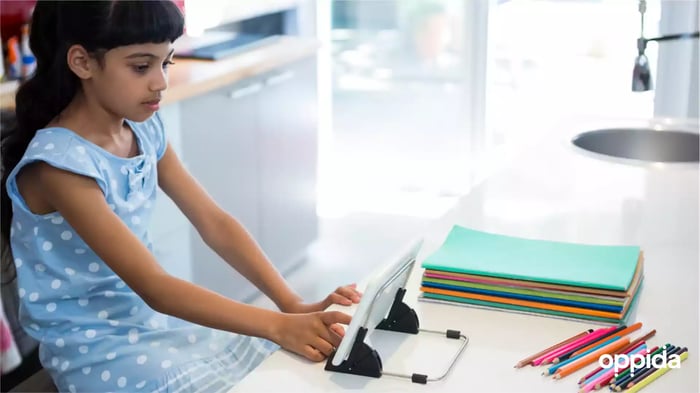
## Kick digital portfolios off with a reflection
Any digital student portfolio requires people to reflect on past projects. At a minimum, people need to choose their best work.
In schools, however, most portfolios showcase growth, rather than exemplary work. So how can we help them show growth?
Teachers need to ask students to produce baseline samples.
This baseline could be a writing sample or a math problem or a checklist of the unit content. We just need to give students a way to track their learning.
Once students have a baseline, it becomes easy for them to track their growth because it is possible to compare the baseline to their results and see progress.
This phrase is also immensely useful for tracking growth:
*Before I used to ______________________, but now I _________________________.*
Here’s an example for numeracy of what it might look like in a digital student portfolio:
**Baseline math sum with previous wrong answer:** 152 + 98 = 140
**Proof of Growth:** 152 + 98 = 250
Imagine an eager 8 or 9-year old student voicing over the photos of their work for the above math problem: “Before I couldn’t carry numbers over in math, but now I know I need to. So 8 + 2 = 10 and I carry the ten to the next column. So, I add 90 + 60 = 150 so I carry the hundred so I add 100 + 100 so I get 250.”
This example illustrates how the student uses critical thinking skills to evaluate what they learned and the progression they made from their original wrong answer. Reflection requires students to defend the strategies they use to find answers, rather than simply regurgitating content given to them by a teacher.
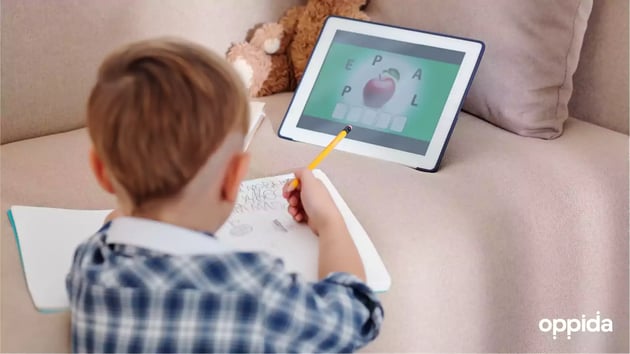
## Provide opportunities for goal setting
Goal setting begins once students have created a baseline and figured out what they need to learn.
But how will they know what goals to set? We call it learning precisely because people don’t understand what they don’t know. There are two ways to give students the tools to set precise goals:
- Create a blueprint
- Share exemplars
### How to create a blueprint
Teachers can help students by writing (and sharing) a blueprint of the skills needed. This blueprint allows students to pinpoint exactly where they are in terms of their learning and point them in the direction they need to go. Check out Chapter 2 in the Sage* Handbook of Research on Classroom Assessment* for more direction on this strategy.
If a teacher also allows students to share learning strategies, they can become more creative as they peer evaluate other students’ ideas. This method has the added benefit of empowering students because they become the experts in the classroom, rather than simply repeating what they’ve already learned.
Content heavy subjects, such as science, lend themselves well to a blueprint of skills. Often students have similar misunderstandings that can be [targeted with specific activities](https://blog.oppida.co/how-to-create-engaging-online-and-at-home-learning-activities).

### Sample Blueprint:
**Knowledge objective:** Students are asked to explain why shorter strings produce higher pitches while longer strings produce lower pitches.
To achieve this, the learning must include:
- Knowing that sound moves in waves.
- Being able to define pitch.
- Understanding that faster sound waves create higher pitches and slower sound waves produce lower pitches.
As demonstrated above, students can make a checklist of which pieces of knowledge they’ve acquired, and which pieces they are still working on.
### How to provide exemplars
Not every skill can be neatly broken down into its disparate parts so these subjects benefit from exemplars.
For example, writing can often be seen as a continuum, rather than a linear journey. In fact, to the frustration of beginning writers, experts often break the rules they learned in school.
Exemplars allow teachers and students to examine what makes a text effective. After they’ve examined it, then the class can start to determine the criteria they want to use to assess their texts.

### Example scenario:
*A teacher may set up exemplars of a creative story at different levels. As a class, the teacher and students have discussed what strategies these texts used to be effective (or ineffective).*
*One student sets the goal of using more action words in her text. Then she goes to the original exemplar to compare her first draft. She may discover that she’s only added one or two action words, while the author in the exemplar added ten.*
*Now she has identified the problem and can set a goal to solve the issue.*
*She may find a thesaurus or talk to a peer or ask her teacher, but she now also has a roadmap for how to start work on solving the identified problem.*
*Goal setting when combined with either co-constructed criteria or a blueprint empowers students to become problem solvers, rather than teacher pleasers.*
## How a digital student portfolio enhances parent communication
A digital student portfolio provides wonderful evidence for parents to see how their child is doing in class.
They also create excellent opportunities for students to practice communication, presentation skills, and digital literacy. Teachers often take on the burden of communicating learning objectives to parents, but if you share these objectives with students then they can demonstrate their abilities for you.
This strategy develops presentation and digital literacy because students perform the same task multiple times. Often students only have a handful of presentations a year, but a digital student portfolio forces students to present much more frequently.
Here’s a basic routine for how you could potentially ask students to communicate with their parents via a digital student portfolio:
- State learning objective
- Show work
- Explain how the work is meeting or not meeting the objective
- Describe their next steps (if they have any)
This basic routine allows students to present their work in a contextualized way so parents know what they’re learning.
A digital student portfolio makes this type of routine easy to implement because it’s pushed directly to parents. With practice, students only need a few minutes to present their work orally to their parents while they would need significantly longer to write a paragraph and then glue it into a physical portfolio.
So there you have it, three ways that a digital student portfolio can foster 21st-century learning skills. What ways are you using digital portfolios? Do you have a favorite platform for creating them?

---
[Edtech](https://blog.oppida.co/tag/edtech), [Education models](https://blog.oppida.co/tag/education-models), [Educational design strategies](https://blog.oppida.co/tag/educational-design-strategies)
## Related posts
[ ](https://blog.oppida.co/21st-century-skills)
[Education trends and insights](https://blog.oppida.co/tag/education-trends-and-insights)
## [What are 21st century skills? (And the 5 easiest ways to teach them in any K–12 classroom)](https://blog.oppida.co/21st-century-skills)
[Oppida Team](https://blog.oppida.co/author/oppida-team)
10/06/2019
At Oppida, we believe that we all need to get better at learning collectively. But how? By giving...
[ Read more ](https://blog.oppida.co/21st-century-skills)
[ ](https://blog.oppida.co/student-voice)
[Communities in education](https://blog.oppida.co/tag/communities-in-education), [Education trends and insights](https://blog.oppida.co/tag/education-trends-and-insights)
## [Boost student voice in your classroom with these 5 digital learning hacks (full guide to 21st century skills)](https://blog.oppida.co/student-voice)
[Oppida Team](https://blog.oppida.co/author/oppida-team)
1/07/2019
This series, entitled, ‘Fostering 21st Century Skills in the digital classroom,’ helps teachers...
[ Read more ](https://blog.oppida.co/student-voice)
[ ](https://blog.oppida.co/teacher-centred-learning)
[Education models](https://blog.oppida.co/tag/education-models)
## [How to move beyond teacher centred learning with this simple shift (unlock real student engagement fast)](https://blog.oppida.co/teacher-centred-learning)
[Bianca Raby](https://blog.oppida.co/author/bianca-raby)
15/07/2019
Since the 11th and 12th centuries, the traditional method of learning involves a teacher centred...
[ Read more ](https://blog.oppida.co/teacher-centred-learning)

```json
{
"@context" : "https://schema.org",
"@id" : "https://oppida.co/#organization",
"@type" : "Organization",
"address" : {
"@type" : "PostalAddress",
"addressCountry" : "AU",
"addressLocality" : "Adelaide",
"addressRegion" : "SA",
"postalCode" : "5000",
"streetAddress" : "Level 2, 70 Hindmarsh Square"
},
"areaServed" : {
"@type" : "Place",
"name" : "Global"
},
"contactPoint" : [ {
"@type" : "ContactPoint",
"areaServed" : "Global",
"availableLanguage" : [ "en" ],
"contactType" : "customer support",
"email" : "hello@oppida.co",
"url" : "https://oppida.co/contact"
} ],
"description" : "Oppida partners with entrusted leaders of learning to design structured, institution-grade capability that strengthens authority, builds human capability, and delivers meaningful real-world impact. Oppida works across strategic program design, course development, rich media production, and AI literacy for everyone.",
"founder" : {
"@id" : "https://oppida.co/#founder",
"@type" : "Person",
"name" : "Bianca Raby",
"sameAs" : [ "https://www.linkedin.com/in/biancaraby/", "https://www.youtube.com/@biancaraby" ],
"url" : "https://biancaraby.com/"
},
"hasOfferCatalog" : {
"@type" : "OfferCatalog",
"itemListElement" : [ {
"@type" : "Offer",
"itemOffered" : {
"@type" : "Service",
"description" : "A focused strategy engagement to clarify audience, purpose, outcomes, delivery direction, risks, and curriculum structure before development begins.",
"name" : "Strategic program design"
}
}, {
"@type" : "Offer",
"itemOffered" : {
"@type" : "Service",
"description" : "Online and blended course development for organisations that need rigorous, well-structured learning aligned to standards, capability outcomes, and long-term delivery.",
"name" : "Course development"
}
}, {
"@type" : "Offer",
"itemOffered" : {
"@type" : "Service",
"description" : "Purposeful video, animation, and interactive media designed to deepen understanding and strengthen learning experiences.",
"name" : "Rich media production"
}
}, {
"@type" : "Offer",
"itemOffered" : {
"@type" : "Service",
"description" : "LMS-ready AI literacy modules that build shared understanding, judgement, and responsible practice across organisations operating in regulated and complex environments.",
"name" : "AI literacy for everyone"
}
} ],
"name" : "Oppida services"
},
"knowsAbout" : [ "learning design", "strategic program design", "course development", "online learning", "blended learning", "instructional design", "rich media production", "video production for learning", "learning management systems", "EdTech ecosystems", "AI literacy", "AI capability development", "adult learning", "higher education", "workforce capability", "institutional learning strategy" ],
"logo" : {
"@id" : "https://oppida.co/#logo",
"@type" : "ImageObject",
"url" : "https://qtrypzzcjebvfcihiynt.supabase.co/storage/v1/object/public/base44-prod/public/9e523cb92_Logo_DarkPurple.png"
},
"name" : "Oppida",
"sameAs" : [ "https://www.linkedin.com/company/oppida/", "https://www.youtube.com/@oppidaco" ],
"slogan" : "Partnering with entrusted leaders of learning to elevate their impact",
"url" : "https://oppida.co/"
}
```
```json
{
"@context" : "https://schema.org",
"@id" : "https://oppida.co/#website",
"@type" : "WebSite",
"description" : "Oppida partners with entrusted leaders of learning to build benchmark-level capability through strategic program design, course development, rich media production, and AI literacy.",
"inLanguage" : "en",
"keywords" : [ "strategic program design", "course development", "learning design", "instructional design", "online course development", "blended learning", "rich media production", "video production for learning", "AI literacy", "AI capability", "LMS-ready learning", "adult learning", "higher education", "government capability", "regulated learning environments" ],
"name" : "Oppida",
"potentialAction" : {
"@type" : "SearchAction",
"query-input" : "required name=search_term_string",
"target" : "https://oppida.co/search?query={search_term_string}"
},
"publisher" : {
"@id" : "https://oppida.co/#organization"
},
"url" : "https://oppida.co/"
}
```
```json
{
"@context" : "https://schema.org",
"@id" : "https://blog.oppida.co/#blog",
"@type" : "Blog",
"description" : "Insights on learning design, course development, strategic capability building, rich media, AI literacy, and thoughtful practice in complex learning environments.",
"inLanguage" : "en",
"isPartOf" : {
"@id" : "https://oppida.co/#website"
},
"name" : "Oppida blog",
"publisher" : {
"@id" : "https://oppida.co/#organization"
},
"url" : "https://blog.oppida.co/"
}
```
```json
{
"@context" : "https://schema.org",
"@id" : "https://blog.oppida.co/digital-student-portfolios#webpage",
"@type" : "WebPage",
"about" : {
"@id" : "https://oppida.co/#organization"
},
"breadcrumb" : {
"@id" : "https://blog.oppida.co/digital-student-portfolios#breadcrumbs"
},
"description" : "Discover all the ways that digital student portfolios can foster 21st Century skills and follow these best practices for classroom implementation here.",
"inLanguage" : "en",
"isPartOf" : {
"@id" : "https://blog.oppida.co/#blog"
},
"mainEntity" : {
"@id" : "https://blog.oppida.co/digital-student-portfolios#article"
},
"name" : "Unlock 6 essential 21st century skills using digital student portfolios (easy guide every teacher can use)",
"primaryImageOfPage" : {
"@id" : "https://blog.oppida.co/digital-student-portfolios#primaryimage"
},
"publisher" : {
"@id" : "https://oppida.co/#organization"
},
"url" : "https://blog.oppida.co/digital-student-portfolios"
}
```
```json
{
"@context" : "https://schema.org",
"@id" : "https://blog.oppida.co/digital-student-portfolios#primaryimage",
"@type" : "ImageObject",
"url" : "https://22642683.fs1.hubspotusercontent-na1.net/hubfs/22642683/Imported_Blog_Media/Digital-student-portfolios-a-must-use-digital-learning-strategy.png"
}
```
```json
{
"@context" : "https://schema.org",
"@id" : "https://blog.oppida.co/digital-student-portfolios#breadcrumbs",
"@type" : "BreadcrumbList",
"itemListElement" : [ {
"@type" : "ListItem",
"item" : "https://oppida.co/",
"name" : "Home",
"position" : 1
}, {
"@type" : "ListItem",
"item" : "https://blog.oppida.co/",
"name" : "Blog",
"position" : 2
}, {
"@type" : "ListItem",
"item" : "https://blog.oppida.co/digital-student-portfolios",
"name" : "Unlock 6 essential 21st century skills using digital student portfolios (easy guide every teacher can use)",
"position" : 3
} ]
}
```
```json
{
"@context" : "https://schema.org",
"@id" : "https://blog.oppida.co/digital-student-portfolios#article",
"@type" : "BlogPosting",
"articleSection" : [ "Edtech", "Education models", "Educational design strategies" ],
"author" : {
"@id" : "https://blog.oppida.co/author/oppida-team#author",
"@type" : "Person",
"name" : "Oppida Team",
"url" : "https://blog.oppida.co/author/oppida-team",
"worksFor" : {
"@id" : "https://oppida.co/#organization"
}
},
"dateModified" : "2026-02-18T04:23:49+0000",
"datePublished" : "2019-07-08T07:42:00+0000",
"description" : "Discover all the ways that digital student portfolios can foster 21st Century skills and follow these best practices for classroom implementation here.",
"headline" : "Unlock 6 essential 21st century skills using digital student portfolios (easy guide every teacher can use)",
"image" : {
"@id" : "https://blog.oppida.co/digital-student-portfolios#primaryimage"
},
"inLanguage" : "en",
"isAccessibleForFree" : true,
"isPartOf" : {
"@id" : "https://blog.oppida.co/#blog"
},
"keywords" : [ "Edtech", "Education models", "Educational design strategies" ],
"mainEntityOfPage" : {
"@id" : "https://blog.oppida.co/digital-student-portfolios#webpage"
},
"publisher" : {
"@id" : "https://oppida.co/#organization"
},
"url" : "https://blog.oppida.co/digital-student-portfolios",
"wordCount" : 1301
}
```
```json
{
"@context" : "https://schema.org",
"@id" : "https://oppida.co/author/oppida-team",
"@type" : "Person",
"image" : {
"@id" : "https://oppida.co/author/oppida-team#image",
"@type" : "ImageObject",
"url" : "https://oppida.co/hubfs/default-avatar.png"
},
"name" : "Oppida Team",
"url" : "https://oppida.co/author/oppida-team",
"worksFor" : {
"@id" : "https://oppida.co/#organization"
}
}
```
```json
{
"@context" : "https://schema.org",
"@id" : "https://blog.oppida.co/digital-student-portfolios#breadcrumb",
"@type" : "BreadcrumbList",
"itemListElement" : [ {
"@type" : "ListItem",
"item" : "https://oppida.co/",
"name" : "Home",
"position" : 1
}, {
"@type" : "ListItem",
"item" : "https://blog.oppida.co/",
"name" : "Blog",
"position" : 2
}, {
"@type" : "ListItem",
"name" : "Unlock 6 essential 21st century skills using digital student portfolios (easy guide every teacher can use)",
"position" : 3
} ]
}
```
```json
{
"@context" : "https://schema.org",
"@id" : "https://blog.oppida.co/digital-student-portfolios#blogpost",
"@type" : "BlogPosting",
"about" : [ {
"@type" : "Thing",
"description" : "Artificial Intelligence in education refers to the use of AI technologies to enhance teaching and learning.",
"name" : "AI",
"sameAs" : "https://en.wikipedia.org/wiki/Artificial_intelligence_in_education"
} ],
"articleBody" : "This series, entitled ‘Fostering 21st Century skills in the digital classroom’ helps teachers incorporate these skills into their lessons today. In this article, we discuss the use of digital student portfolios. If you want to find out more about 21st Century skills, check out the first two posts:
\n\n\n21st Century skills are becoming increasingly important in the Australian market so it’s clear we need to think about how we can incorporate them into our classrooms.
\nCreating a digital student portfolio can easily foster these skills. They teach six out of the eight 21st Century skills identified by the Foundation for Young Australians:
\n\n- Critical thinking
\n- Problem-solving
\n- Creativity
\n- Communication
\n- Presentation skills
\n- Digital literacy
\n
\nA digital student portfolio doesn’t just foster 21st Century skills, educational research also suggests that a digital student portfolio enhances student learning. One study, published in the British Journal of Education Technology, found improvement in “reflection, self-assessment, continuous improvement, goal setting, problem-solving, data gathering, work, and peer interaction” (p. 358)”. It meets the gold standard of scientific methods since they used a test and a control group.
\nNow you know why you should use a digital student portfolio, but classroom implementation for this learning technique can be tricky. By following the tips and tricks in this article, you’ll be able to easily incorporate a digital student portfolio in your practice.
\n
\nKick digital portfolios off with a reflection
\nAny digital student portfolio requires people to reflect on past projects. At a minimum, people need to choose their best work.
\nIn schools, however, most portfolios showcase growth, rather than exemplary work. So how can we help them show growth?
\nTeachers need to ask students to produce baseline samples.
\nThis baseline could be a writing sample or a math problem or a checklist of the unit content. We just need to give students a way to track their learning.
\nOnce students have a baseline, it becomes easy for them to track their growth because it is possible to compare the baseline to their results and see progress.
\nThis phrase is also immensely useful for tracking growth:
\nBefore I used to ______________________, but now I _________________________.
\nHere’s an example for numeracy of what it might look like in a digital student portfolio:
\nBaseline math sum with previous wrong answer: 152 + 98 = 140
\nProof of Growth: 152 + 98 = 250
\nImagine an eager 8 or 9-year old student voicing over the photos of their work for the above math problem: “Before I couldn’t carry numbers over in math, but now I know I need to. So 8 + 2 = 10 and I carry the ten to the next column. So, I add 90 + 60 = 150 so I carry the hundred so I add 100 + 100 so I get 250.”
\nThis example illustrates how the student uses critical thinking skills to evaluate what they learned and the progression they made from their original wrong answer. Reflection requires students to defend the strategies they use to find answers, rather than simply regurgitating content given to them by a teacher.
\n
\nProvide opportunities for goal setting
\nGoal setting begins once students have created a baseline and figured out what they need to learn.
\nBut how will they know what goals to set? We call it learning precisely because people don’t understand what they don’t know. There are two ways to give students the tools to set precise goals:
\n\n- Create a blueprint
\n- Share exemplars
\n
\nHow to create a blueprint
\nTeachers can help students by writing (and sharing) a blueprint of the skills needed. This blueprint allows students to pinpoint exactly where they are in terms of their learning and point them in the direction they need to go. Check out Chapter 2 in the Sage Handbook of Research on Classroom Assessment for more direction on this strategy.
\nIf a teacher also allows students to share learning strategies, they can become more creative as they peer evaluate other students’ ideas. This method has the added benefit of empowering students because they become the experts in the classroom, rather than simply repeating what they’ve already learned.
\nContent heavy subjects, such as science, lend themselves well to a blueprint of skills. Often students have similar misunderstandings that can be targeted with specific activities.
\n
\nSample Blueprint:
\nKnowledge objective: Students are asked to explain why shorter strings produce higher pitches while longer strings produce lower pitches.
\nTo achieve this, the learning must include:
\n\n- Knowing that sound moves in waves.
\n- Being able to define pitch.
\n- Understanding that faster sound waves create higher pitches and slower sound waves produce lower pitches.
\n
\nAs demonstrated above, students can make a checklist of which pieces of knowledge they’ve acquired, and which pieces they are still working on.
\nHow to provide exemplars
\nNot every skill can be neatly broken down into its disparate parts so these subjects benefit from exemplars.
\nFor example, writing can often be seen as a continuum, rather than a linear journey. In fact, to the frustration of beginning writers, experts often break the rules they learned in school.
\nExemplars allow teachers and students to examine what makes a text effective. After they’ve examined it, then the class can start to determine the criteria they want to use to assess their texts.
\n
\nExample scenario:
\nA teacher may set up exemplars of a creative story at different levels. As a class, the teacher and students have discussed what strategies these texts used to be effective (or ineffective).
\nOne student sets the goal of using more action words in her text. Then she goes to the original exemplar to compare her first draft. She may discover that she’s only added one or two action words, while the author in the exemplar added ten.
\nNow she has identified the problem and can set a goal to solve the issue.
\nShe may find a thesaurus or talk to a peer or ask her teacher, but she now also has a roadmap for how to start work on solving the identified problem.
\nGoal setting when combined with either co-constructed criteria or a blueprint empowers students to become problem solvers, rather than teacher pleasers.
\nHow a digital student portfolio enhances parent communication
\nA digital student portfolio provides wonderful evidence for parents to see how their child is doing in class.
\nThey also create excellent opportunities for students to practice communication, presentation skills, and digital literacy. Teachers often take on the burden of communicating learning objectives to parents, but if you share these objectives with students then they can demonstrate their abilities for you.
\nThis strategy develops presentation and digital literacy because students perform the same task multiple times. Often students only have a handful of presentations a year, but a digital student portfolio forces students to present much more frequently.
\nHere’s a basic routine for how you could potentially ask students to communicate with their parents via a digital student portfolio:
\n\n- State learning objective
\n- Show work
\n- Explain how the work is meeting or not meeting the objective
\n- Describe their next steps (if they have any)
\n
\nThis basic routine allows students to present their work in a contextualized way so parents know what they’re learning.
\nA digital student portfolio makes this type of routine easy to implement because it’s pushed directly to parents. With practice, students only need a few minutes to present their work orally to their parents while they would need significantly longer to write a paragraph and then glue it into a physical portfolio.
\nSo there you have it, three ways that a digital student portfolio can foster 21st-century learning skills. What ways are you using digital portfolios? Do you have a favorite platform for creating them?
\n
\n
",
"audience" : {
"@type" : "Audience",
"audienceType" : [ "Higher Education", "K-12 Teachers" ]
},
"author" : {
"@id" : "https://oppida.co/author/oppida-team"
},
"citation" : [ ],
"dateModified" : "2026-02-18T04:13:30.826Z",
"datePublished" : "2019-07-08T07:42:00Z",
"description" : "Unlock 6 essential 21st century skills using digital student portfolios (easy guide every teacher can use)",
"headline" : "Unlock 6 essential 21st century skills using digital student portfolios (easy guide every teacher can use)",
"image" : {
"@id" : "https://blog.oppida.co/digital-student-portfolios#primaryimage",
"@type" : "ImageObject",
"height" : 630,
"url" : "https://22642683.fs1.hubspotusercontent-na1.net/hubfs/22642683/Imported_Blog_Media/Digital-student-portfolios-a-must-use-digital-learning-strategy.png",
"width" : 1200
},
"keywords" : "",
"mainEntityOfPage" : {
"@id" : "https://blog.oppida.co/digital-student-portfolios#webpage"
},
"mentions" : [ {
"@type" : "Thing",
"description" : "Artificial Intelligence in education refers to the use of AI technologies to enhance teaching and learning.",
"name" : "AI",
"sameAs" : "https://en.wikipedia.org/wiki/Artificial_intelligence_in_education"
} ],
"publisher" : {
"@id" : "https://oppida.co/#organization"
},
"wordCount" : 1289
}
```
```json
{
"@context" : "https://schema.org",
"@id" : "https://blog.oppida.co/digital-student-portfolios#faq",
"@type" : "FAQPage",
"isPartOf" : {
"@id" : "https://blog.oppida.co/digital-student-portfolios#webpage"
},
"mainEntity" : [ {
"@type" : "Question",
"acceptedAnswer" : {
"@type" : "Answer",
"text" : "Teachers can help students by writing (and sharing) a blueprint of the skills needed. This blueprint allows students to pinpoint exactly where they are in terms of their learning and point them in the direction they need to go. Check out Chapter 2 in the Sage Handbook of Research on Classroom Assessment for more direction on this strategy. If a teacher also allows students to share learning strategies, they can become more creative as they peer evaluate other students’ ideas. This method has the added benefit of empowering students because they become the experts in the classroom, rather than simply repeating what they’ve already learned. Content heavy subjects, such as science, lend themselves well to a blueprint of skills. Often students have similar misunderstandings that can be targeted with specific activities ."
},
"name" : "Provide opportunities for goal setting: How to create a blueprint"
}, {
"@type" : "Question",
"acceptedAnswer" : {
"@type" : "Answer",
"text" : "Not every skill can be neatly broken down into its disparate parts so these subjects benefit from exemplars. For example, writing can often be seen as a continuum, rather than a linear journey. In fact, to the frustration of beginning writers, experts often break the rules they learned in school. Exemplars allow teachers and students to examine what makes a text effective. After they’ve examined it, then the class can start to determine the criteria they want to use to assess their texts."
},
"name" : "Provide opportunities for goal setting: How to provide exemplars"
}, {
"@type" : "Question",
"acceptedAnswer" : {
"@type" : "Answer",
"text" : "A digital student portfolio provides wonderful evidence for parents to see how their child is doing in class. They also create excellent opportunities for students to practice communication, presentation skills, and digital literacy. Teachers often take on the burden of communicating learning objectives to parents, but if you share these objectives with students then they can demonstrate their abilities for you. This strategy develops presentation and digital literacy because students perform the same task multiple times. Often students only have a handful of presentations a year, but a digital student portfolio forces students to present much more frequently. Here’s a basic routine for how you could potentially ask students to communicate with their parents via a digital student portfolio: State learning objective Show work Explain how the work is meeting or not meeting the objective Describe their next steps (if they have any) This basic routine allows students to present their work in a contextualized way so parents know what they’re learning. A digital student portfolio makes this type of routine easy to implement because it’s pushed directly to parents. With practice, students only need a few minutes to present their work orally to their parents while they would need significantly longer to write a paragraph and then glue it into a physical portfolio. So there you have it, three ways that a digital student portfolio can foster 21st-century learning skills. What ways are you using digital portfolios? Do you have a favorite platform for creating them?"
},
"name" : "How a digital student portfolio enhances parent communication"
} ],
"publisher" : {
"@id" : "https://oppida.co/#organization"
}
}
```