Cognitive load theory is one of the most practically useful frameworks in learning design, and one...
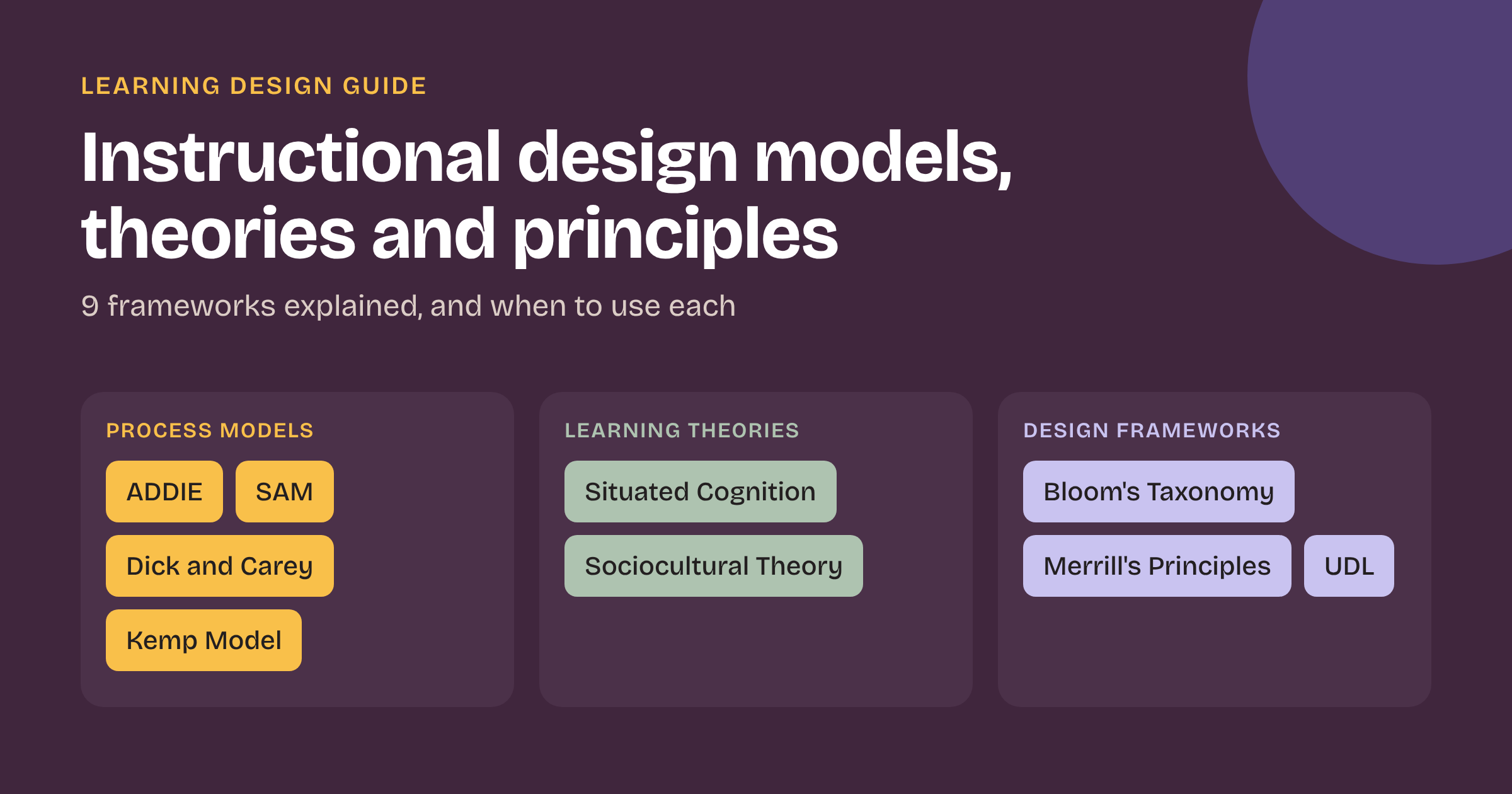
Instructional design models are structured approaches for planning, building and evaluating learning. The most widely used are ADDIE, SAM, Dick and Carey, and the Kemp Model. Theories and principles such as Bloom's Taxonomy, Merrill's Principles of Instruction and Universal Design for Learning (UDL) guide the decisions you make inside those models.
Whether you're building a corporate program, a university subject or an online course, how you structure content shapes what people actually learn. The frameworks below give you a tested starting point, so you're not reinventing the process each time.
This guide covers nine of the most influential models, theories and principles. For each one, you'll see what it is, why it's useful and when to use it. At the end, there's a side-by-side comparison and a simple way to choose the right mix for your project.
In this guide
- ADDIE
- Bloom's Taxonomy
- Merrill's Principles of Instruction
- Situated Cognition
- Sociocultural Learning Theory
- Universal Design for Learning (UDL)
- Successive Approximation Model (SAM)
- Dick and Carey Model
- The Kemp Model
Models, theories and principles: what's the difference?
The three terms are often used interchangeably, but they do different jobs.
- Models describe the process of designing a course, step by step (for example, ADDIE and SAM).
- Theories explain how people learn (for example, Situated Cognition and Sociocultural Theory).
- Principles and frameworks turn theory into practical design rules (for example, Bloom's Taxonomy, Merrill's Principles and UDL).
Most good courses use at least one of each.
1. ADDIE: the five-phase process model
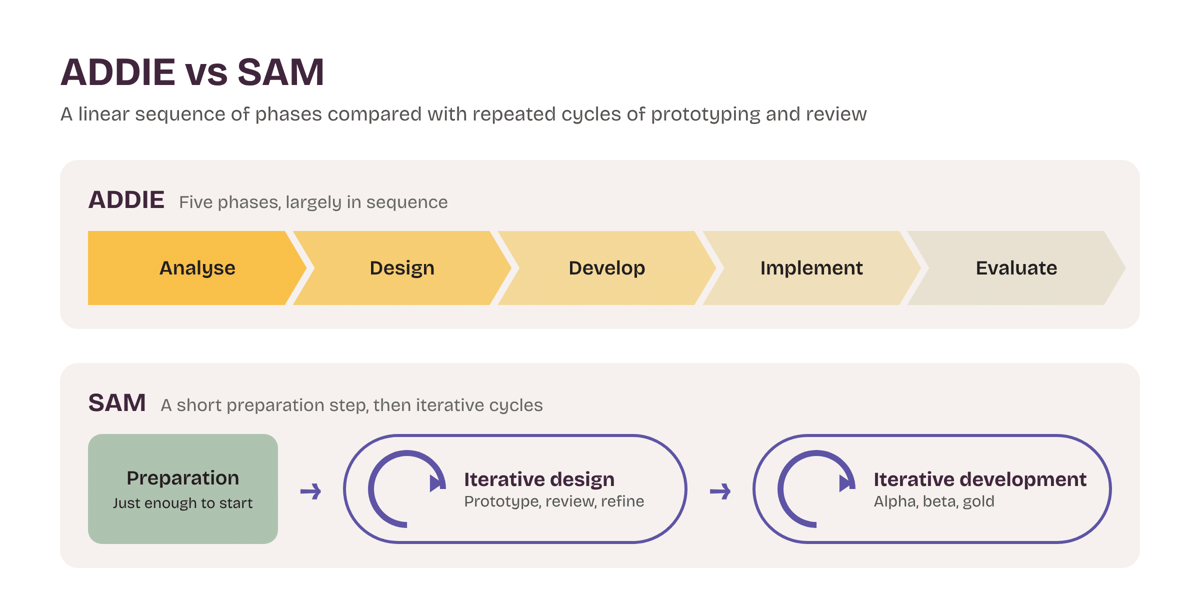
ADDIE is a five-phase instructional design process: Analyse, Design, Develop, Implement and Evaluate. It is the most widely taught model and suits large or high-stakes projects that need clear planning and sign-off points.
What it is
ADDIE was developed in the mid-1970s for US military training and has since become the foundation for many other models. Its five phases are:
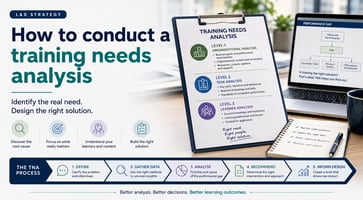
- Analyse: Identify the learning need, the audience, the objectives and any constraints. A training needs analysis is usually the first step.
- Design: Plan the learning experience, including content, sequence, activities and assessments.
- Develop: Build the materials, such as modules, videos, activities and job aids.
- Implement: Deliver the course in your LMS, classroom or blended format.
- Evaluate: Measure whether objectives were met and identify improvements.
Why it's useful
ADDIE keeps objectives, content and assessment aligned. Because each phase has a clear output, it's easy to manage, document and get stakeholder sign-off.
When to use it
Use ADDIE for large programs, compliance training or any project where skipping analysis would be costly. It's often criticised as slow and linear, but you can build review cycles into each phase. Many newer models, including SAM, are adaptations of ADDIE.
2. Bloom's Taxonomy: levels of thinking
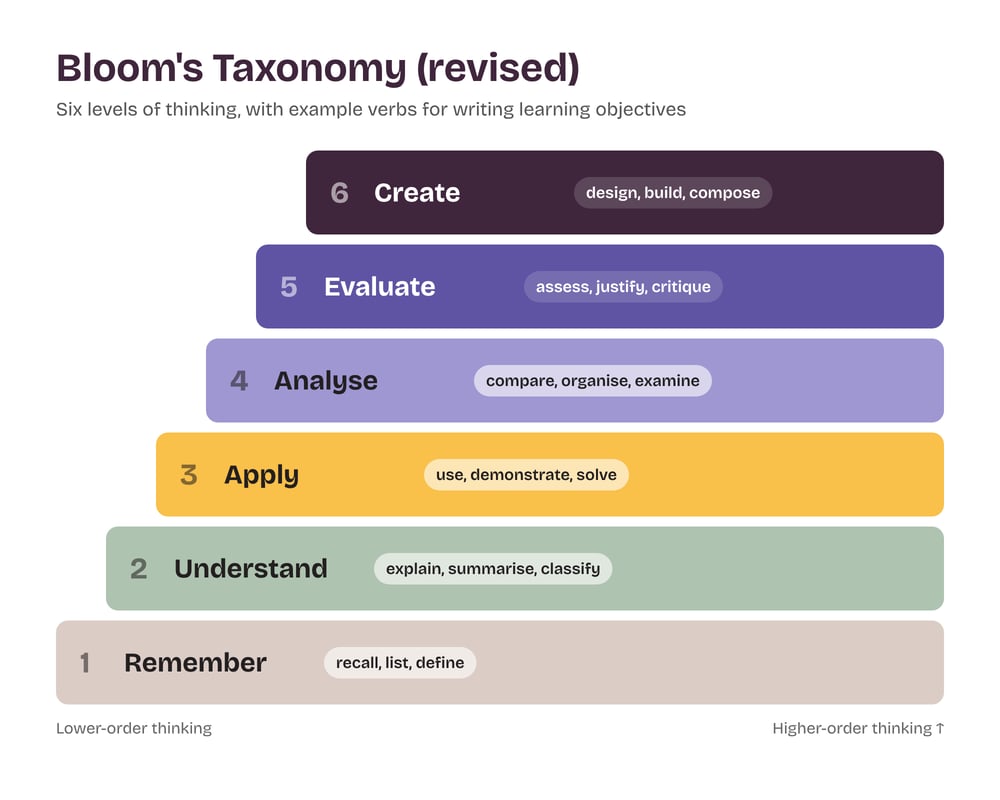
Bloom's Taxonomy classifies learning objectives into six levels of thinking, from remembering facts to creating something new. Designers use it to write measurable objectives and to make sure courses go beyond recall.
What it is
Benjamin Bloom and colleagues published the original taxonomy in 1956. A revised version (Anderson and Krathwohl, 2001) uses six levels:
- Remember: Recall facts and terms.
- Understand: Explain ideas in your own words.
- Apply: Use knowledge in a new situation.
- Analyse: Break information into parts and see how they relate.
- Evaluate: Make and justify a judgement.
- Create: Combine ideas to produce something new.
Why it's useful
Bloom's gives you the verbs for clear, measurable objectives. It also shows quickly when a course relies too heavily on recall. For example, instead of asking staff to memorise safety rules, ask them to apply the rules to a realistic scenario.
When to use it
Use it whenever you write objectives, assessment items or activities. If most of your tasks sit at Remember and Understand, add at least one Analyse, Evaluate or Create task.
3. Merrill's Principles of Instruction: learning through real tasks
Merrill's Principles of Instruction state that people learn best when they solve real-world problems, build on what they already know, see a demonstration, practise with feedback and apply the skill in their own context.
What it is
David Merrill published his First Principles of Instruction in 2002 after reviewing many instructional theories. The five principles are:
- Problem-centred: Frame learning around realistic tasks from the start.
- Activation: Connect new learning to what learners already know.
- Demonstration: Show how the task is done, with clear examples.
- Application: Let learners practise, with feedback.
- Integration: Help learners transfer the skill to their own work through reflection, discussion or a project.
Why it's useful
Merrill's principles keep training practical. Learners can see why the content matters, which improves motivation and retention. They also align well with adult learning principles.
When to use it
Use it for skills-based training, such as onboarding, software training, customer service or clinical skills. If your course is mostly slides, ask: what real problem should learners be able to solve by the end?
4. Situated Cognition: learning in context
Situated Cognition is a learning theory that says knowledge is tied to the context where it is learned and used. It recommends learning through authentic tasks in realistic settings, rather than abstract instruction.
What it is
The theory is closely linked to Brown, Collins and Duguid (1989) and to Lave and Wenger's work on communities of practice. Its key ideas are:
- Learn in an environment that resembles where the skill will be used.
- Knowing and doing are connected: people learn by doing real tasks.
- Learning is often social, as in apprenticeships where novices take on more responsibility over time.
Why it's useful
Skills practised in realistic contexts transfer better to the job. This theory is the reason scenarios, simulations and work-based projects tend to outperform lectures for applied skills.
When to use it
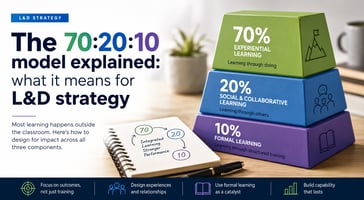
Use it when transfer to the workplace is the goal. In online courses, use branching scenarios, case studies and realistic data. The 70:20:10 model applies similar thinking by recognising how much learning happens on the job.
5. Sociocultural Learning Theory: learning with others
Sociocultural Learning Theory, based on the work of Lev Vygotsky, holds that people learn through social interaction and the cultural tools around them. Its best-known ideas are the Zone of Proximal Development and scaffolding.
What it is
The theory's main ideas are:
- Zone of Proximal Development (ZPD): The gap between what a learner can do alone and what they can do with guidance. This is where learning is most productive.
- Scaffolding: Temporary support, such as worked examples, checklists or coaching, that is gradually removed as learners become capable.
- Language and culture: The language, tools and cultural context learners bring shape how they understand new ideas.
Why it's useful
It shows that discussion, collaboration and coaching are central to learning, not optional extras. It also reminds designers to make examples and scenarios relevant to diverse learners.
When to use it
Use it when designing group work, mentoring, peer review or facilitated sessions. For self-paced courses, add a discussion space, a live session or a buddy system so learners can learn from each other.
6. Universal Design for Learning (UDL): designing for everyone
Universal Design for Learning (UDL) is a framework for designing courses that work for as many learners as possible from the start. It is based on three principles: multiple means of engagement, representation, and action and expression.
What it is
UDL was developed by CAST, which publishes the UDL Guidelines. Instead of adding accommodations later, you plan for learner variability upfront:
- Engagement: Offer choice, relevance and different ways to stay motivated.
- Representation: Present information in more than one format, such as text, audio, video and visuals.
- Action and expression: Give learners different ways to show what they know, such as a written response, a recording or a presentation.
Why it's useful
UDL makes courses more accessible and more flexible. Changes made for accessibility, like captions and transcripts, usually help everyone. Read more in our guide to Universal Design for Learning.
When to use it
Use it on almost every project, since almost every audience is diverse. Start with captions, transcripts, readable layouts and at least one choice in how learners complete an assessment.
7. Successive Approximation Model (SAM): the iterative model
The Successive Approximation Model (SAM) is an agile instructional design model that uses rapid prototypes and repeated feedback cycles instead of a linear process. It suits projects with tight timelines or changing requirements.
What it is
SAM was introduced by Michael Allen in 2012 as an alternative to ADDIE. The extended version has three phases:
- Preparation: Gather just enough background to start, often in a short kickoff session.
- Iterative design: Build quick prototypes, review them with stakeholders and learners, then refine.
- Iterative development: Build the course in cycles (alpha, beta, gold), testing and adjusting as you go.
Why it's useful
Issues are found early, when they're cheaper to fix. Stakeholders see the course take shape, which reduces late surprises.
When to use it
Use SAM when content is likely to change, timelines are short or stakeholders are unsure what they want. It works only if reviewers are available for quick feedback, so plan review cycles and subject matter expert workload before you start.
8. Dick and Carey Model: the detailed systems approach
The Dick and Carey Model is a systematic instructional design model with ten connected steps, from identifying goals to summative evaluation. It is known for tightly aligning objectives, assessments and instruction.
What it is
Walter Dick and Lou Carey first published the model in 1978 in The Systematic Design of Instruction. The steps are:
- Identify instructional goals.
- Conduct an instructional analysis.
- Analyse learners and contexts.
- Write performance objectives.
- Develop assessment instruments.
- Develop an instructional strategy.
- Develop and select instructional materials.
- Design and conduct formative evaluation.
- Revise instruction.
- Design and conduct summative evaluation.
Why it's useful
Every part of the course links back to a goal, and assessments are written before content. Formative evaluation acts as built-in quality assurance before full rollout.
When to use it
Use it for formal programs where rigour and documentation matter, such as certification, professional accreditation or government training. For smaller projects it can feel heavy, but the core habit of aligning goals, objectives and assessment is always worth keeping.
9. The Kemp Model: the flexible, non-linear model
The Kemp Model (also called the Morrison, Ross and Kemp Model) is a non-linear instructional design model. It lists nine elements to consider, which designers can address in any order and revisit as the project develops.
What it is
The model is usually drawn as a circle, with the nine elements interacting:
- Instructional problems
- Learner characteristics
- Task analysis
- Instructional objectives
- Content sequencing
- Instructional strategies
- Designing the message
- Instructional delivery
- Evaluation instruments
Support services, planning and ongoing revision sit around the outside of the model.
Why it's useful
Real projects rarely run in a neat sequence. Kemp accepts that and still gives you a complete checklist, including areas other models skip, like learner support and delivery logistics.
When to use it
Use it for complex or evolving programs, such as multi-course curricula, blended programs or microlearning libraries. If ADDIE feels too rigid but you still want structure, Kemp is a good middle ground.
How to choose the right instructional design model
You don't need to pick just one. Most effective courses combine a process model with the theories and principles that fit the content. Start with these four questions:
- How stable are the requirements? Stable and high stakes: ADDIE or Dick and Carey. Likely to change: SAM.
- How complex is the program? Many modules, stakeholders or delivery modes: Kemp.
- What should learners be able to do? Write objectives with Bloom's, and build practice around real tasks with Merrill's Principles and Situated Cognition.
- Who are your learners? Plan for diversity with UDL, and build in interaction using Sociocultural Theory.
For example, you might manage the project with SAM, write objectives with Bloom's, design activities with Merrill's Principles and check accessibility against UDL. All in the same course.
Instructional design models compared
Here's a side-by-side comparison of the nine frameworks and what each brings to the table.
| Model or theory | Type | Focus | Strengths | Best used when |
|---|---|---|---|---|
| ADDIE | Process model | Five phases: Analyse, Design, Develop, Implement, Evaluate | Clear structure, easy to manage and document | Large or high-stakes projects that need thorough planning |
| Dick and Carey | Process model | Ten steps aligning goals, objectives and assessment | Rigorous, strong alignment, built-in formative evaluation | Formal programs needing detailed documentation |
| SAM | Agile process model | Rapid prototypes and feedback cycles | Fast, flexible, catches issues early | Tight timelines or changing requirements |
| Kemp Model | Non-linear process model | Nine elements addressed in any order | Adaptable, learner-centred, comprehensive | Complex or evolving programs |
| Bloom's Taxonomy | Framework | Six levels of thinking for objectives | Measurable objectives, builds higher-order thinking | Writing objectives and assessments |
| Merrill's Principles | Principles | Real tasks, demonstration and practice | Practical, improves engagement and retention | Skills-based and workplace training |
| Situated Cognition | Learning theory | Learning through authentic tasks in context | Better transfer to the real world | Simulations, scenarios and on-the-job learning |
| Sociocultural Theory | Learning theory | Social interaction, ZPD and scaffolding | Uses collaboration and mentoring | Group work, peer learning and coaching |
| UDL | Framework | Multiple means of engagement, representation and expression | Accessible and flexible for all learners | Almost every project, especially diverse audiences |
Each model or theory has its niche. The best results come from choosing the right mix for your situation:
- Need structure and a proven process? ADDIE or Dick and Carey.
- Working on a fast-moving project? SAM.
- Want more engagement and realism? Merrill's Principles and Situated Cognition.
- Aiming for inclusivity? UDL, always.
- Underpinning everything: understand your learners (Kemp and Sociocultural Theory) and what they need to achieve (Bloom's).
Using AI in instructional design
AI tools can now draft outlines, quiz questions, scenarios and media in minutes. The models in this guide still matter, because they tell you what to ask AI for and how to judge what it gives back.
A few practical ways to combine them:
- Analysis: Use AI to summarise survey responses or interview notes, then check the themes yourself.
- Objectives: Ask AI to draft objectives at a specific Bloom's level, then edit for accuracy and context.
- Practice: Generate first drafts of scenarios for Merrill-style practice, then have a subject matter expert review them.
- Accessibility: Use AI to produce transcripts, captions and alternative formats in line with UDL.
- Prototyping: Speed up SAM's prototype cycles by drafting rough versions faster.
The risk is using AI to produce more content, rather than better learning. Keep a human designer responsible for alignment, accuracy and learner experience. For more, see So, your organisation is using AI? and our article on cognitive offloading.
Frequently asked questions
Next steps
Choosing a model is easier when you're clear on your goals, audience and resources. If you're planning a new program, our organisational readiness guide walks you through the questions to answer first. If you're deciding whether to build in-house or bring in support, read How to decide whether to build your course in-house or bring in a specialist partner.
When you're ready to talk about your project, see how Oppida approaches course development.
References
- Anderson, L. W., and Krathwohl, D. R. (2001). A Taxonomy for Learning, Teaching, and Assessing: A Revision of Bloom's Taxonomy of Educational Objectives. Longman.
- Allen, M. (2012). Leaving ADDIE for SAM. ASTD Press.
- Brown, J. S., Collins, A., and Duguid, P. (1989). Situated cognition and the culture of learning. Educational Researcher, 18(1), 32–42.
- CAST. The UDL Guidelines. udlguidelines.cast.org
- Dick, W., Carey, L., and Carey, J. O. The Systematic Design of Instruction. Pearson.
- Merrill, M. D. (2002). First principles of instruction. Educational Technology Research and Development, 50(3), 43–59.
- Morrison, G. R., Ross, S. M., Morrison, J. R., and Kalman, H. K. Designing Effective Instruction. Wiley.
- Vygotsky, L. S. (1978). Mind in Society: The Development of Higher Psychological Processes. Harvard University Press.